AI agents for sales in 2026: comparing approaches
Choose an AI agent for your sales team based on the task. For a handful of repetitive questions, a bot builder with AI answers is enough. For a stream of leads in messengers, a cloud service will do. If the sale is complex, with questioning and a measurement visit, you need an agent built around your rules: it runs the deal in the CRM on its own and calls in a manager at the right moment.
Four types of AI agents for sales on the 2026 market
Tuesday, 22:40, a chat on an Avito listing. A customer writes: “Hello, a three-metre kitchen with an island. How long will it take, and can I do it without prepayment?” The manager will see the message in the morning. The question is who replies now and what they manage to get done before morning.
Under the label “AI sales agent” four different solutions are sold today. In ads they look alike. The difference shows on a message like this one, where the customer writes in their own words and asks about two things at once. What an agent is in principle and how it differs from a chatbot, we covered in our overview of AI agents for business. Here we compare the types of solutions you will come across once you start choosing.
Demand for such solutions is already there. According to ComNews, January 2026, 39% of Russian companies use AI agents and AI assistants, and 25% of companies apply them in sales. The study was conducted by SberAnalytics and Sber Business Soft.
A button-based bot builder with AI answers
The bot is assembled in a builder from blocks: greeting, menu, branches, phone number capture. AI is embedded in one of the blocks and answers from an uploaded knowledge base. The customer can ask in their own words and get an answer. The backbone remains the script: if the conversation drifts, the bot steers the person back to the buttons.
To the kitchen message, such a bot will most likely reply about lead times from the knowledge base and offer a choice: “Calculate the cost” or “Contact a manager”. The prepayment question may get lost along the way.
A subscription cloud service: the “AI salesperson”
A ready-made platform. You sign up, upload your price list and answers to frequent questions, and connect channels from a list. Many services have a ready-made integration with popular CRMs. The model understands free text and keeps the thread of the conversation. The working rules are the same for all of the service's clients. They are adapted to your funnel within the limits the developer has left.
Such a service will happily discuss the kitchen: it answers about lead times from the knowledge base, and about prepayment if the payment terms were added there. The lead goes to the CRM with a standard set of fields.
Built-in AI features of the CRM
CRM platforms are adding AI to their products. Bitrix24 has the CoPilot assistant: it transcribes calls, pulls the key points out of a conversation and fills in empty fields in the card. amoCRM has a built-in Salesbot builder for scripts and auto-replies in connected messengers. The feature set depends on the plan and changes, so check it with the platform itself.
The strength of these features is that they live inside the CRM. Their main job is to help the manager: less manual data entry, faster conversation review. Free-form chat with a customer by your sales rules is a separate task, and the built-in features are worth testing for it separately.
An AI agent built for your company's task
Such an agent is built around your process. It is connected to your CRM and channels and works by your playbooks: which questions to ask, when to offer a measurement visit, at what point a person takes over the conversation. It understands free text, recognises the customer across all channels and creates the deal itself: stage, fields, a task for the manager.
Flexibility has a flip side. You need written-down sales rules or a willingness to formulate them. You need real chats to test the agent on before launch. A vendor sets it up, so the quality of support after launch becomes one of your criteria when choosing. What makes up the cost is covered in the article on the price of a chatbot and an AI agent.
The replies are an illustrative example of how each type of solution typically behaves. What ends up in the CRM by morning is described in the article. A specific product may answer better or worse than its type, which is why such replies are checked in a test.
Comparing AI agents for sales on seven criteria
The table sums up the typical behaviour of each type. A specific product may go beyond these limits in either direction. So read the table as a list of questions for whoever is selling you the solution.
| Criterion | Bot builder with AI | Cloud AI salesperson | CRM AI features | Custom company agent |
|---|---|---|---|---|
| Understands free text | In the AI block; everything else runs on buttons | Yes | The assistant understands the conversation text; chat auto-replies usually follow a script | Yes, taking your rules into account |
| Remembers the conversation history | Within the script and saved fields | Within the dialogue, sometimes per customer | The full history sits in the CRM card | Customer history from all channels and from the CRM |
| Runs the deal in the CRM: fields, stages, tasks | Passes the contact and lead on via an integration | Creates a deal and fills in standard fields | Works right inside the card, fills in fields from the conversation | Moves it through stages, fills in your fields, sets tasks |
| Telegram, WhatsApp, Avito and the website at once | Often a separate script for each channel | Channels from the service's list | Channels connected to the CRM | One agent for all your channels |
| Hands over to a manager by clear rules | Via a button or a script branch | By the service's general rules | The manager already works in the CRM | On your signals, with a conversation summary |
| Who sets it up and updates it | You or a contractor, in the builder | You, following instructions; the service updates the platform | A CRM admin or integrator; the platform updates the features | The vendor together with you; you can edit the answer base too |
| What it suits | Frequent repetitive questions and contact capture | Standard sales with a clear catalogue | Taking load off managers inside the CRM | Sales with questioning, a quote and booking |
The first two rows look the same for almost everyone: modern models understand natural speech. The differences hide further down, in the rows about the CRM, channels and handover to a person. They don't show up in a demo, which is exactly why you should ask about them.
Where the differences show most: the CRM and handover to a manager
In a demo, all four types answer smoothly. The difference shows after a week of work, when you open the deal cards.
Back to the kitchen. The bot builder passed the name and phone number to the CRM. The cloud service created a deal and attached the chat. The custom agent found out the length, the island, the budget and a convenient day, set the “Survey booked” stage and created a task for the manager for Wednesday morning. The manager calls with full context and doesn't ask again what the customer has already said.
An illustrative example based on the kitchen message from the article. Reply times, island size and budget are made up for the example. What the agent found out, which stage it set and who got the task is described in the article.
The second place where the types diverge is the handover to a person. Friday, 19:15, WhatsApp: “Others offered me a lower price. Can you match it?” The button bot will show a menu. The cloud service will reply by its general rules, and it's good if they include a ban on promising discounts. The custom agent will spot the “haggling” signal, tell the customer who will reply and when, and send the manager a short summary.
Write down the handover signals in advance, in the words of your own process: a question about the exact price, haggling, a complaint, a non-standard order, a request to call. How the agent talks to the customer meanwhile is shown below, in the section on what to tell a customer when a robot answers.
Which AI agent suits a sales team: three scenarios
The answer lies in your own chats. Open the messages from the last month across all channels and look at three things: how repetitive the questions are, how many channels there are and at what hours people write, and what needs to happen before a deal. From there, almost any business falls into one of three scenarios.
A few repetitive questions
A nail salon, a small shop, a workshop. People ask the same things: where are you, what time do you close, is there a slot on Saturday. A bot builder with AI answers or a script inside the CRM is enough here. Watch one thing: the contact must land in the CRM right away, without manual transfer from the builder's dashboard.
Lots of leads in messengers
Leads come from Telegram, WhatsApp and Avito, managers reply with a delay, and some people write at night. In a live GetGate project where our sales robot works, 27% of leads come in during evenings and weekends. Previously, all of them waited until morning. With a standard catalogue, a cloud service will do. If a lead needs questioning and taking all the way to a booking, look at a custom agent.
Complex sales with a measurement visit
Windows, kitchens, gates, renovation. The order is expensive, the customer takes a long time to decide, and before quoting a price you need dimensions, an address and a measurement visit. This calls for an AI agent built for your company's task. It will ask the questions, book the measurement visit, create the deal and hand the customer over to a manager once the conversation reaches the exact price.
The pairs of statements follow the article's three scenarios: a few repetitive questions, lots of leads in messengers, a complex sale with a measurement visit. “Check first” is the last column of the scenario table.
| Scenario | Signs in the chats | What fits | What to check first |
|---|---|---|---|
| A few repetitive questions | Questions repeat almost word for word, few leads | Bot builder with AI or a CRM script | Whether the contact gets into the CRM without manual transfer |
| Lots of leads in messengers | Several channels, delayed replies, messages at night | Cloud service or custom agent | Whether the agent recognises a customer writing in different channels |
| Complex sales with a measurement visit | Questioning, quoting, booking, an expensive order | Agent built for the company's task | Stages, fields and tasks in the CRM, rules for handover to a manager |
Questions for the vendor before buying an AI agent
The same questions work for a subscription service, a CRM integrator and a vendor who will build an agent for you. What matters is not only the answers but how specific they are.
| Question | A to-the-point answer | An answer that should worry you |
|---|---|---|
| Which fields and stages does the agent fill in the CRM? | They show you the fields and stages of yours it writes to | “Everything goes to the CRM” |
| How are the channels connected? | Official Telegram, WhatsApp and Avito interfaces | Logging in with your manager's username and password |
| On what signals does the agent call in a manager? | A list of signals and a sample notification with a conversation summary | “It'll figure it out itself” |
| Who updates the answers when terms change? | You edit the base; the vendor monitors quality | Any change only through the vendor |
| What does the agent do when it doesn't know the answer? | Says it will check and hands over to a manager | “It answers everything” |
| Does the agent understand voice messages and photos? | Yes, and they show it with an example | “Customers usually write text” |
| How is the agent tested before launch? | A run on your real chats; the first 20 dialogues are read in full | “It's all set up, let's launch” |
| Where are the chats stored? | They name the storage location and the procedure for handling personal data | Can't answer right away |
Ask separately what will happen a month after launch. Prices change, new services appear, customers ask questions that weren't in the base. Someone has to read the dialogues and fix the answers. If that person isn't named, it will end up being your manager.
Testing: awkward questions for an AI agent
A vendor's demo always follows a convenient script. Ask for test access and write to the agent yourself, the way your most difficult customer writes. Here are the questions on which solution types diverge fastest.
- Two questions in one message. “How much is it and when can you come?” The agent must answer both, not just the first.
- Haggling. “It's cheaper elsewhere, will you give me a discount?” The agent doesn't promise a discount; it hands the conversation to a manager.
- A question outside the knowledge base. “Do you work with customer-supplied materials?” A good agent will honestly say it will check. A bad one will make up an answer.
- A change of topic. Start with the kitchen, ask about delivery, go back to the dimensions. The agent must remember what you were talking about.
- A voice message or photo. Send a voice message saying “the opening is two by three, can you do it?” or a photo of the wall.
- Irritation. “This is the third time I've written the same thing.” A menu in reply to that spoils the impression of the whole company.
- A direct question. “Are you a robot?” Decide in advance what the agent answers, and check that it answers exactly that way.
After the test, open the CRM. Did a deal appear, which fields are filled in, is there a task for the manager, is the whole chat visible? A test that leaves the CRM empty has checked nothing.
Don’t expect flawless answers. We compared answers blind on real conversations: in 80% of cases the assistant’s answer was rated no worse than a human’s. The remaining cases are a reason to read the first dialogues in full and fix the knowledge base.
This check is easy to repeat on your own conversations. Take past requests, collect the manager’s answer and the agent’s answer, remove the labels and give them to someone who does not know which is which. It takes an evening and shows the quality on your customers, not on someone else’s niche.
You can’t judge by a single channel. In chat the agent has the whole context in front of it. Voice messages have to be recognised accurately, and on a call it also has to answer without delay when interrupted. It makes sense to start with chat: quality is higher there and the cost of a mistake is lower.
What to tell a customer when a robot answers
Don’t pass the agent off as a person. Customers almost always guess: from the even pace of replies, from the same politeness at three in the morning. They usually find out at a bad moment, when they are already annoyed, and a second grievance joins the first: they were deceived. What annoys people is silence and not being able to reach a person; the robot itself rarely does.
There’s no need to announce “you are talking to artificial intelligence” in the first line either. A greeting that makes clear whom the customer has reached is enough: “Hello! I’m the company’s assistant. I’ll answer questions about our services and find a time for a call with a specialist.” An assistant’s name is fine. The name and photo of a real employee turn silence into outright deception.
A direct question “Is this a bot?” gets a direct answer: “Yes, I’m an automated assistant. I answer based on what I know about our services and pass complex questions straight to a manager.” After such an answer the conversation usually goes on: the person asked so they would know what to expect.
The handover to a person is put into words too: “A manager will handle this question better; I’ve passed our conversation on. They will reply within the working day.” The customer learns what is happening, that the context is not lost and when to expect a reply. The last point matters most: uncertainty irritates more than waiting.
Three things the agent never says: figures that are not in your data, promises on the company’s behalf such as a discount or a refund, and opinions about competitors. An invented price becomes a company promise the moment it is sent, and a discount is a decision for a person.
What to do if the agent gave a customer a wrong answer
Mistakes happen with every type of solution, so agree on the procedure in advance. First, stop the auto-reply and switch the conversation to a manager instead of trying to fix the wording right in the chat. Then record to whom, in which channel and to which question the wrong answer was given. Don’t delete or edit the agent’s message: it is what you use to find the cause.
Write to the customer plainly, without technical explanations: “Sorry, a bot answered here and it made a mistake. Maria will write to you in ten minutes.” A specific time is better than a vague “during the day”, if you can actually keep it. Send the corrected price or date as a separate message so it doesn’t get lost in the apology.
If the customer has already relied on the wrong condition, a person with authority decides: honour the promise as an exception, compensate part of it, or explain the mistake and decline. It is better to set in advance the limit up to which a manager decides alone. How to choose the words for such a conversation is covered in our article on how to apologise to a customer.
The cause is found in one of three places, and each is fixed differently:
| What broke | Criterion | What to fix |
|---|---|---|
| Agent instructions | Answered a different question from the one the customer asked | Refine the instructions, leave the data alone |
| Knowledge base | Old price, a discontinued service, wrong terms | Update the source the agent takes its facts from |
| CRM link-up | The agent is silent or can’t see the deal data | Fix the channel and field connection; the reply text has nothing to do with it |
Each case is marked in the deal card with a tag such as “assistant error”, with the actual excerpt of the conversation attached. A month later you can see whether mistakes repeat on one topic and where to fix them.
Three counters reveal a problem before complaints do: the share of dialogues handed to a manager, the share of errors in a weekly sample of conversations, and the time a person takes to reply after a handover. A share of handovers that is too low is also a warning: the agent is guessing where it should call a person.
Where to start when choosing an AI agent for sales
- Export the last month's chats from all channels.
- Note which questions repeat and at what hours customers write.
- Put into one sentence what a ready lead means for you.
- Write down the signals on which a manager takes over the conversation.
- Use the scenario table to pick a type of solution and ask vendors the questions from the checklist.
- In the test, go through the awkward questions and check what's left in the CRM.
If your review shows you need an agent for complex sales, take a look at how we built our sales robot. It replies within seconds at any time, understands free text, finds out the task, timing and budget, books a measurement visit or a call and creates the deal in amoCRM itself. One agent works in Telegram, WhatsApp, on Avito and on the website. It hands the customer over to a manager when it comes to the price or a complex question.
And where else AI comes in handy in a sales team, beyond the first reply to a customer, is collected in our breakdown of implementing AI in business.
Frequently asked questions.
Which AI agent suits a sales team?
The one that handles your main task. The last month's chats will point you to the answer.
If questions repeat and there are few leads, a bot builder with AI answers is enough. If leads come from several messengers, including at night, look at a cloud service or an agent connected to the CRM. If the price requires questioning and a measurement visit, you need an AI agent built for your company's task.
Can you get by with the built-in AI in amoCRM or Bitrix24?
Yes, if the goal is to take load off managers inside the CRM: transcribe calls, fill in fields, set up a simple auto-reply script.
If you need free-form chat with customers by your sales rules across all channels at once, check that in a test. The set of built-in features depends on the plan and changes, so verify it with the platform itself.
How is a cloud AI salesperson different from a custom company agent?
In the scope for customisation. A cloud service works by general rules set by its developer: you upload a knowledge base and connect channels from a list.
A custom agent is built around your funnel: which fields to fill in, which stage to put the deal in, when to call in a manager. There's more preparation at the start, but the agent runs the deal the way your team does.
Will an AI agent replace a sales manager?
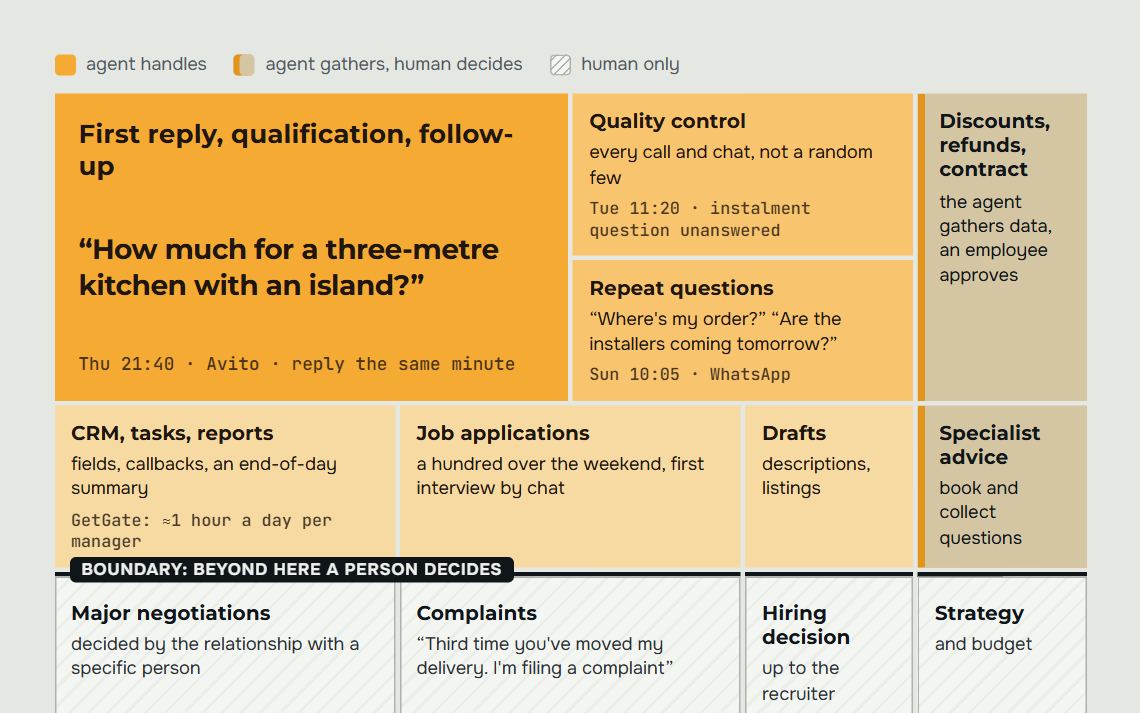
No. The agent takes on the first reply, questioning, booking a measurement visit or a call, and filling in the card, especially at night and on weekends.
Haggling, complaints, non-standard orders and conversations about the exact price stay with the manager. A good agent hands such a conversation to a person along with a short summary, and the manager picks up where the agent left off.
How do you test an AI agent before buying?
Ask for test access and write to the agent yourself, the way your most difficult customer writes.
Ask two questions in one message, haggle, ask something that isn't in the knowledge base, send a voice message. Watch whether the agent makes up answers and whether it calls in a manager on time. After the test, open the CRM: a deal with filled-in fields and a task for the manager should appear there.
What should you do if an AI agent gave a customer a wrong answer?
Stop the auto-reply, hand the conversation to a manager and write to the customer plainly: the bot made a mistake, here is the correct information, here is who will continue and when. Don’t delete the agent’s message; it is used to find the cause.
The cause is usually in one of three places: the agent’s instructions, an outdated knowledge base or a failure in the CRM connection. If the customer has already relied on the wrong condition, a person with authority makes the decision.
Let's audit your business
Leave a request and on a free consultation we'll find where customers are being lost, suggest which service to start with and price it around your goal.
Rather not fill in a form? Message our agent on Telegram — it replies right away and books you a review.