AI in marketing: where it works and where to start
AI in marketing takes over repetitive work: drafts of texts and ads, pulling analytics together across channels, customer-base segments and the first reply to a lead. Decisions about meaning, facts and money stay with people. Start with one task and one metric, and measure the effect all the way to cost per lead and payment.
Where AI is useful in marketing
AI does well where there is a lot of repetitive work and a clear pattern to follow. Sketching a dozen headlines for an ad. Breaking down an export of ad spend by channel. Reading a hundred reviews and summing up what customers complain about. Replying to someone who left an enquiry late on a Saturday evening.
It does worse where a decision is needed. Which product to promote, what price to set, what to promise the client — these questions stay with the owner and the marketer. Below are six areas where AI already works in marketing, and what in each of them remains a human job.
Businesses are moving in cautiously. According to ComNews, January 2026, 39% of Russian companies use AI agents and AI assistants. 25% of companies use them to automate marketing. The study was conducted by SberAnalytics and Sber Business Soft.
| Area | What AI does | What stays with a person |
|---|---|---|
| Content and content factories | Transcripts, drafts of posts and articles, video scripts, repackaging one piece into different formats | Topic, company position, fact-checking, final edit |
| Ad creatives and copy | Variants of headlines, copy and images for different segments and platforms | Choosing hypotheses, budget, compliance with advertising law |
| SEO and AI answers | Collecting search queries, mapping them to pages, structure, draft answers to FAQs | First-hand experience, examples, figures and sources |
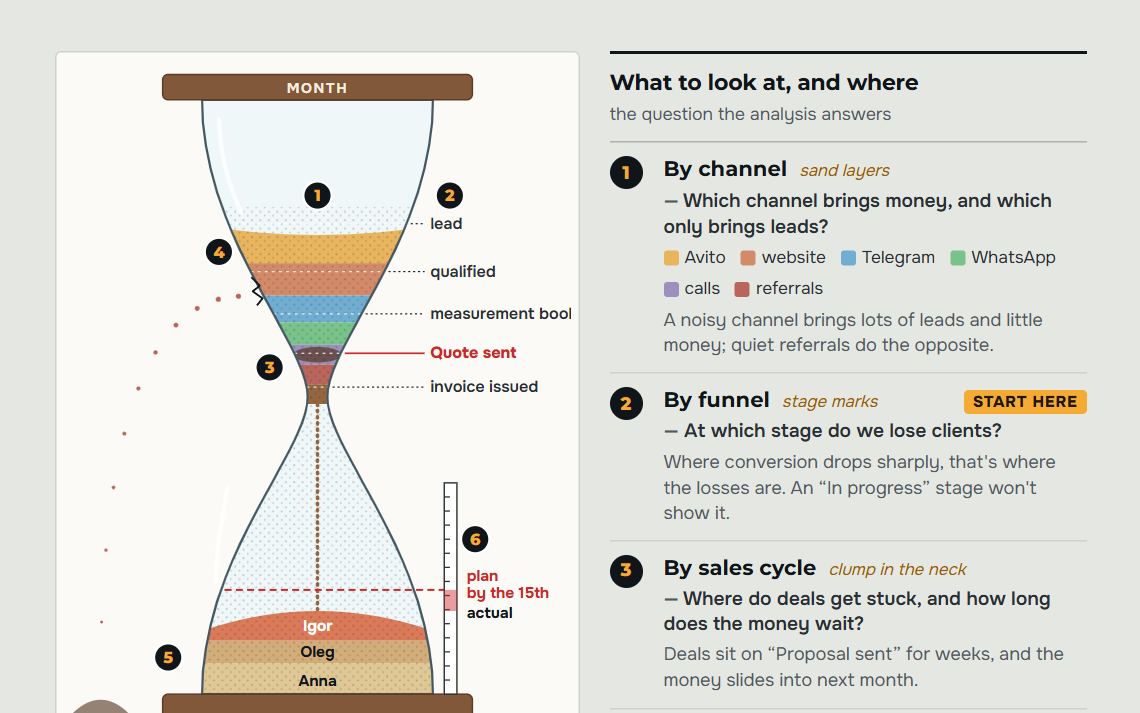
| Payback analytics | Matches spend, leads and payments by channel, looks for anomalies | The decision on where to move the money |
| Segmentation and personalisation | Splits the customer base by behaviour and purchases, writes messages for each group | Rules on whom to message and how often, mailing consent |
| Incoming leads | First reply at any hour, clarifying questions, a deal in the CRM | Haggling, complaints, complex and large orders |
Content and content factories
A content factory is a publishing stream in which one idea turns into several formats. An hour-long interview with an executive becomes an article, three Telegram posts, a short video script and a newsletter email. AI handles the transcription, cutting and first drafts. The editor keeps the vivid details and strikes out the generic phrases.
Without an editor, the factory quickly starts turning out identical texts. Readers recognise them from the first paragraph, and so does search. That is why in the factory AI owns the draft, while people own the meaning and the facts.
Ad creatives and copy
Advertising on Yandex Direct, VK or Avito needs lots of variants: for different customer groups, platforms and formats. In one evening AI will sketch dozens of headlines and descriptions. The marketer picks a few hypotheses and runs them at the same time on equal budgets. A week later it is clear which variant brings in leads more cheaply.
Judge by the leads and sales in your CRM. Click-through rate says little about money: a catchy headline easily gathers clicks from people who will never buy anything.
SEO and AI answers
Some people now get the answer straight from Yandex's Alice assistant or from a quick answer in search, and never reach the website. The neural network builds such an answer from pages that have a direct definition, a table, a step-by-step sequence and answers to frequent questions. AI helps collect search queries, map them to pages and prepare the structure.
A text written entirely by a machine adds nothing to dozens of similar pages and has little chance of making it into an answer. The pages that get into answers carry the company's own experience: real examples, its own figures, an analysis of mistakes.
Channel payback analytics
Monday, nine in the morning. The marketer is pulling reports together: spend from Direct, leads from Metrica, deals from amoCRM. Three spreadsheets, different channel names, some leads without a tag. AI helps bring it into one picture: match leads to deals, find where the tag got lost and highlight the channel where cost per lead went up over the week.
The decision on where to move the budget is still made by a person. But now it is made across the whole chain, from a rouble spent on ads to payment, rather than on clicks.
Segmentation and personalisation
The customer base in a CRM often sits there as dead weight, and everyone gets the same mailing. AI splits the base by behaviour: who bought once and disappeared, who asked about the price and never came back, who buys every season. For each group it writes its own version of the message; the marketer checks and approves it.
Personalisation is good as long as it is appropriate. An email saying “You looked at this item late last night” is creepy. An email saying “The season is starting, your model is back in stock” is helpful. A person sets the rules on whom to message and how often, and you may only write to those who have consented to receive mailings.
Marketing that doesn't lose leads
Talk about AI in marketing usually ends with content and advertising. Right after that comes the place where money is lost most often. A lead has come in, and there is nobody to reply. The ad did its job, the click is paid for, and the person waits until morning and goes to whoever replied first.
Friday, half past ten at night. A message arrives on Avito: “Hello, do you deliver to the suburbs? I need it next week.” A price question comes in from the website to WhatsApp. The manager is already at home. On Monday morning he replies to both, and one of them has already bought from another seller.
In our live GetGate project, 27% of leads came in during evenings and weekends, and all of them used to wait for a reply until morning. For marketing, this is a direct loss: the acquisition money has already been spent, and part of the flow goes cold without an answer.
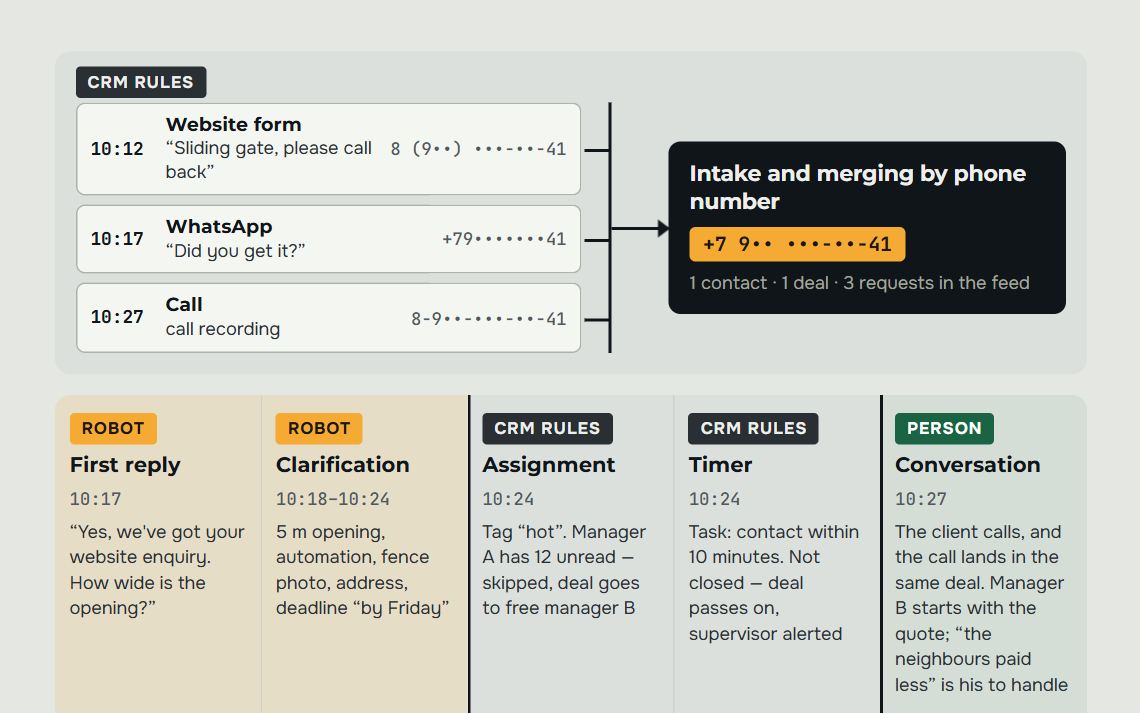
AI closes this gap in two steps. First, it sorts the flow: it separates spam, bots and random messages from real leads and flags the hot ones. We covered how to tell one from the other in the article on how not to lose a hot enquiry among the junk.
Then the sales robot replies to the person in Telegram, WhatsApp, on Avito or on the website, clarifies the task and creates a deal in the CRM. In the morning, the manager gets a list of clients who have already been questioned, with the outcome of each conversation. AI marketing is there so that the sales robot has someone to work with. The robot is there so that paid-for leads don't go to waste.
When every lead sits in the CRM with a channel tag, the real cost per lead becomes visible. You count a person who answered the questions and got as far as booking, and you see which channel brings conversations that end in payment.
Hello, do you deliver to the suburbs? I need it next week.the manager is already at homeAvito
Yes, we deliver. What's the address, and what needs to be delivered?Clarifies the task while the client is still on the line.Avito
Hypothetical example: the times, the robot's reply and the counter figures are made up. The client's question, the 27% of evening leads at GetGate and the rule of counting only real leads with a channel tag are taken from the article.
Where AI in marketing doesn't work or is dangerous
Businesses already write content with neural networks en masse, but almost nobody publishes it without editing. According to a study by the Go Influence agency, which CNews published in August 2026, 73% of companies use AI to create content. 89% of companies edit the result themselves, and only 4% publish it unprocessed. Among the concerns are factual errors and the loss of a recognisable style.
Made-up facts
A neural network writes confidently even where it knows nothing. It can invent a product specification, a warranty condition, an expert quote or a figure from a study that never existed. In a blog post that is embarrassing. In a product card or a reply to a client, it is already grounds for a complaint.
The rule is simple. Everything about price, timing, specifications and promises, AI takes from your documents: the price list, the catalogue, the delivery terms. If there is no data, it says “I'll check with a manager”. A person checks every figure in a publication before it goes out.
Identical content
Ask a neural network to write a post about the benefits of your service, and it will produce a text like thousands of others. It doesn't hook the reader, and there is nothing to make it stand out in search. What sets a company apart is the details: a client's remark, a mistake on site, a photo from the warehouse, an argument within the team.
Give AI raw material: call transcripts, questions from WhatsApp chats, notes from the site. Then the draft will be about you. A brief along the lines of “write a post about our advantages” produces emptiness.
Legal risks
- Personal data. Uploading your customer base to a third-party AI service may violate personal data law. Anonymise exports or work with services where it is clear in which country and with whom the information is stored.
- Advertising. Online advertising in Russia must be labelled, and the advertiser is responsible for the ad copy. A neural network will easily write “the best in town” or “the cheapest” without proof, and you will be the one held responsible.
- Images. A generated image may turn out to resemble someone else's work or a trademark. For advertising and packaging, make sure it contains no third-party logos or recognisable people.
- Reviews. Generated reviews mislead buyers. Avito and marketplaces fight them, and an exposed fake damages trust more than an honest average rating.
How to start bringing AI into marketing: a step-by-step plan
Start with one task where the losses are visible in money. Most often it is either a flow of leads you don't have enough hands for, or content that comes out once a month. Then the order is as follows.
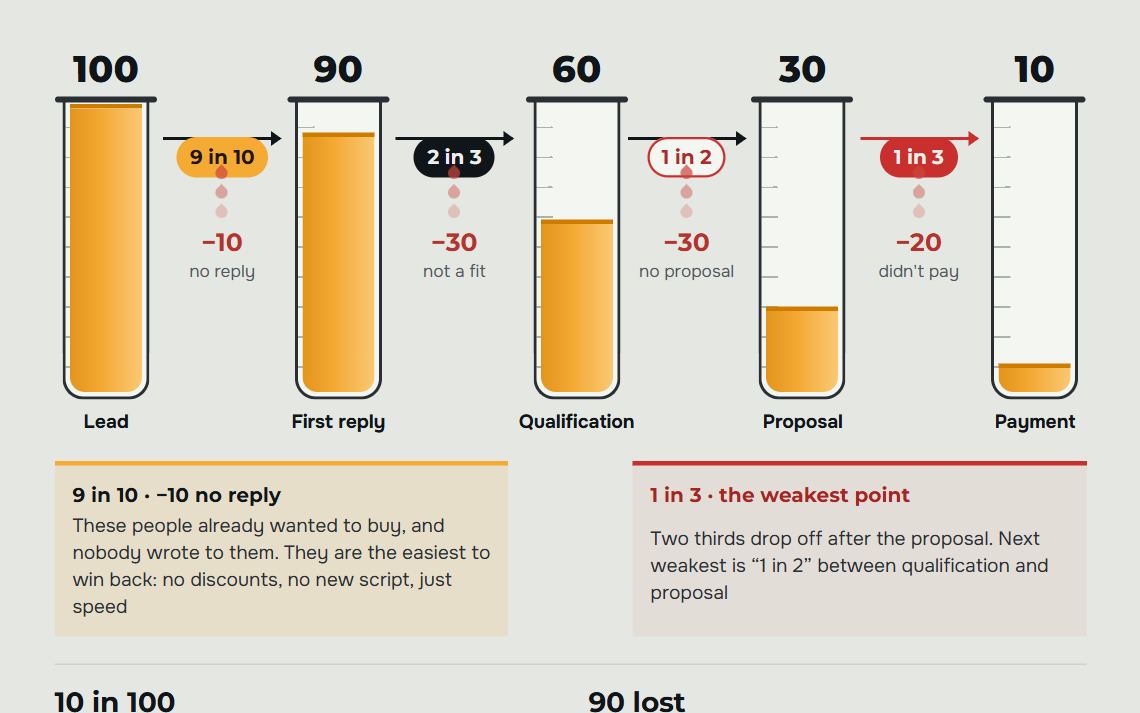
- Measure your funnel as it is today. Take the last month: spend by channel, number of leads, how many got a reply and how quickly, how many made it to payment. Without this baseline you won't be able to measure the effect later.
- Find where leads or time are being lost. Leads wait until morning, channel tags go missing, the report takes a week to compile, the blog has stalled.
- Choose one task and one metric. For example: “first reply to Avito leads at any hour; we track how many got as far as booking.” Or: “blog articles from call transcripts; we track leads from those pages.”
- Gather raw material for AI. Price list, catalogue, FAQs, real conversations, samples of texts you like. This determines whether the result will sound like your company.
- Connect everything to your CRM. A lead from any channel must land in amoCRM or Bitrix24 with a source tag. Otherwise cost per lead remains guesswork.
- Launch on one channel and read the results yourself. Go through the first 20 dialogues or publications in full: where AI made mistakes, where it started speaking in someone else's voice.
- Compare the metric with the baseline. Only then expand to other channels and tasks.
The steps, the task of first replies to Avito leads and the 20 dialogues for review are taken from the article. The heights of the “before” and “after” bars are an example.
The general order for implementing AI in a company, from analysing processes to scaling, is set out on the page about AI implementation for business.
The effect of AI in marketing: which metrics to track
Measure the effect on the task you handed to AI, and compare it with the month before launch. Hours saved matter, but the owner cares about something else: are more leads reaching payment on the same ad budget?
| Task | What AI does | Which metric to watch |
|---|---|---|
| Content for the blog and social media | Drafts from transcripts and chats, repackaging into different formats | Publications per month, leads from pages and posts, editor time per piece |
| Ad copy and creatives | Variants for customer groups and platforms | Cost per lead and share of leads reaching a deal, for each variant |
| SEO and AI answers | Search queries, page structure, answers to FAQs | Impressions and clicks from search, appearances in Alice's answers, leads from search |
| Channel analytics | Brings spend, leads and payments into one picture | Cost per lead and cost per sale for each channel, return on ad spend |
| Customer base segmentation | Groups by behaviour, messages for each group | Repeat purchases, replies to mailings, unsubscribes |
| First reply to a lead | Replies at any hour, asks questions, creates a deal | First reply time, unanswered leads, share reaching booking or payment |
Tuesday, team meeting. The marketer shows that leads from Avito have gone up noticeably over the month. The head of the company opens amoCRM and sees that the same number of people as before got as far as booking. So the new ads are pulling in the wrong kind of buyers. Track the metric to the end of the funnel, to payment, or it is easy to mistake growth in leads for growth in sales.
AI in marketing: in-house or with a contractor
A marketer can master post drafts, ad variants and review analysis on their own using publicly available neural networks. Which other business tasks neural networks handle with a clear return is covered in the article on neural networks for business.
You need a contractor when AI has to work inside a process: taking leads from all channels, writing to the CRM, matching spend with payments, producing content as a stream. Here, what matters is how the parts are linked; a standalone text service won't change the picture.
We build this kind of setup in our service “Marketing + AI”: strategy and positioning, content factories, landing pages and websites, SEO and paid advertising, payback analytics. Leads from marketing go straight to the sales robot and into the CRM. That is why cost per lead is visible for every channel, and it is clear what you are paying for.
Frequently asked questions.
How do you use AI in marketing?
Start with one task where the losses are visible in money: leads wait for a reply until morning, content comes out rarely, the channel report takes a week to compile.
Record the metric for the last month, give AI your materials — price list, catalogue, real conversations — and launch on one channel. Read the first dialogues or publications in full, and only then expand.
Will AI replace the marketer?
No. AI takes on drafts, ad variants, compiling reports and the first reply to a lead.
The marketer decides what to promote and to whom, chooses hypotheses, checks facts and is responsible for the final text. With AI, one person gets more done, but the company's positioning and budget decisions stay with them.
Can you publish texts written by a neural network without editing?
Better not. A neural network confidently invents specifications, terms and figures that don't exist, and writes like thousands of other texts.
Give it raw material about your company: call transcripts, customer questions, notes from sites. A person checks every figure, price and promise before publication.
Which metrics show the effect of AI in marketing?
Those tied to money, for the task you handed to AI. For advertising — cost per lead and the share of leads that reach a deal. For the inbound flow — first reply time and unanswered leads.
Compare with the month before launch and follow through to payment in the CRM: a rise in leads without a rise in sales means AI is attracting the wrong people.
How does AI connect marketing and sales?
Through leads. AI filters out spam and flags hot enquiries, while the sales robot replies in Telegram, WhatsApp and on Avito at any hour, questions the client and creates a deal in the CRM.
When every lead sits in the CRM with a channel tag, the real cost per lead becomes visible, and it is clear which channel brings clients who get as far as payment.
Let's audit your business
Leave a request and on a free consultation we'll find where customers are being lost, suggest which service to start with and price it around your goal.
Rather not fill in a form? Message our agent on Telegram — it replies right away and books you a review.