Lead qualification: how to pick out the hot leads
Lead qualification is a handful of questions that sort enquiries into hot, warm and cold: the task, the deadline, the budget, who decides, the location. Ask them one at a time, as part of the conversation. A chat robot does this straight away, sets the temperature in amoCRM and hands the hot ones to a manager, while the “not now” ones get a date for the next touch.
Lead qualification: why your sales team needs it
Tuesday, 10:05. A manager has twelve new leads in amoCRM from this morning. One says: “We need a sliding gate for our plot, the posts are already in, we want it done before the cold sets in.” Another just says “How much?”. The third came from a student writing a term paper. The manager calls them in the order they arrived and won't get to the first one until after lunch.
Lead qualification decides who to call first, who to send a quote to and whom to let go without wasted effort. A lead is assessed on several criteria and given a temperature: hot, warm or cold. The rules are written down once, and the whole team works by them, regardless of any particular manager's mood or workload.
The team gets three things out of this. A hot client hears back before they cool off. A manager spends the day on people ready to buy and handles the warm ones on a separate plan. The head of sales sees in the pipeline how many real buyers came in, and argues with the marketer about lead quality using CRM data.
Filtering out spam, mistakes and random enquiries is a separate task, covered in the section on junk enquiries below. Most of the article is about the next step: how to assess real enquiries and how to hand this work to a robot.
Criteria for assessing a lead
A good scheme rests on criteria the client can name themselves in the first few minutes of the conversation. For most small-business niches, the set is similar:
- Task. What the person wants and how clearly they describe it. “A gate for a four-metre opening, with automation” and “interested in gates” are different enquiries.
- Timing. “Before the cold sets in”, “in time for the move in March” or “just looking for now”.
- Budget. A ballpark figure is enough: does the client's expectation fit your price range?
- Who decides. The client alone, together with a spouse, via the director and the accounts department.
- Location. Whether you work in that area and what the trip out will cost.
- Readiness for the next step. Whether the person agrees to a measurement, a meeting, a trial lesson or an invoice.
Every niche has its key criterion. In apartment renovation, it's the date the keys are handed over. In education, it's who pays: the adult themselves or their parents. In B2B supplies, it's whether the company has a budget for this quarter or the purchase has been postponed.
Choose the criteria from your own sales history; textbooks won't guess them for you. Open the last twenty paid deals and twenty lost ones in the CRM. Reread the first messages and find what set the buyers apart right from the start. Usually it's two or three criteria, and they become the basis of the scheme.
“Hello, we need gates for our country house by May, the plot's in Istra. What would it cost?”
Hypothetical example in the spirit of the article: gates, Istra, a voice message on Saturday evening. The client named the timing and area himself, so the robot doesn't ask again. The rule “timing and measurement confirmed — hot” comes from the section on agreeing on wording.
BANT for small business: what to keep and what to reorder
The best-known qualification framework is BANT: budget, authority, need, timeline. IBM came up with it for large sales, where a deal takes months to approve and it's crucial to find the person who signs early on. It has relatives: CHAMP starts with the client's challenge, ANUM puts authority and need ahead of money.
For a small business, BANT is useful as a reminder that a lead has more than one dimension. The order is worth changing, though. Start with the task and the timeline: clients talk about them readily, and their answer often tells you everything else. Discuss the budget last and through options, otherwise the very first question about money sounds like a credit check.
In consumer sales, authority looks softer. Someone buying a kitchen rarely says “I'm not the one who decides.” They say “I'll show my wife tonight.” For qualification, that's useful information: send the quote in a format that's easy to forward and agree on a call after the family has looked at it.
Small businesses have to add two signs themselves. The first is geography: a client from the neighbouring region can be ideal by BANT and useless to you. The second is readiness for a specific step. An enquiry where the person asked “when can you come?” unprompted is hotter than one where the budget is named but the client isn't ready for a measurement yet.
Hot, warm, cold: agree on the words in advance
Temperature only works if everyone understands it the same way. Describe each one in a sentence or two and pin it up next to the pipeline. An example for a company that installs gates:
- Hot: the task is clear, the timeline is under two months, you serve the area, the client agrees to a measurement.
- Warm: there's a task, but the timeline is vague or the decision is someone else's.
- Cold: “just checking the price”, no timeline, or the client is outside your area.
Without that agreement, temperature turns into a gut feeling. On Monday morning one manager marks a client hot because they chatted politely. Another marks as cold someone who asked about paying in instalments. A month later the report shows plenty of hot leads, sales haven't moved, and there's no longer any way to work out where the mistake is.
Scoring points for each criterion works when you have hundreds of leads and a long-tuned scheme. At the start, simple “if–then” rules are easier. If the timeline and the measurement are confirmed, the lead is hot. If there's no timeline, it's warm. Rules like these are easy to check by eye and just as easy to hand over to a robot.
How to ask about budget and timing without losing the client
Thursday, 19:10, WhatsApp: “How much are sliding gates?”. A weak reply is a questionnaire: width, height, material, automation, address, timing, budget. The client sees seven questions on the screen and goes to whoever named any price at all first. Every question in qualification should give the client something in return.
A good reply starts with something useful: “Ready-made kits start at such-and-such, the exact price depends on the width of the opening. How wide is yours?” One question, and it's clear why it's needed. The next one comes after the answer to the previous one, as in a normal chat with a salesperson.
A few techniques that ease the tension:
- ask about timing through an event: “What date does it need to be done by?” sounds more natural than “When are you planning to buy?”;
- find out the budget by offering a choice: “Are you looking at an option with automation, or without for now?” — the answer itself will show the ballpark figure;
- ask about the decision-maker with care: “Who else should I send the quote to, so you don't have to forward it?”;
- clarify location together with the visit: “Which village is the plot in? I'll check when our surveyor is nearby.”
If a client doesn't want to answer, don't push. Mark the sign as unknown and move on. An empty field is more honest than an invented one, and the manager will fill in what's missing in conversation.
Cheat sheet by criterion: what to ask and how to read the answer.
| Criterion | Question to the customer | What the answer means |
|---|---|---|
| Task | “How wide is the opening, and do you need automation?” | Size and type given: the task is clear; “interested in gates”: one more question is needed |
| Timing | “What date do you need it by?” | A date or event is named: closer to hot; “just looking for now”: warm or cold |
| Budget | “Are you looking at an option with automation, or without for now?” | The option chosen shows the ballpark figure without a direct question about money |
| Who decides | “Who else should I send the quote to, so you don’t have to forward it?” | “I’ll show my wife”: send the quote in an easy-to-forward form and agree on a call |
| Location | “Which village is the plot in? I’ll check when our surveyor is nearby” | Within your area: criterion met; outside it: cold, even if everything else fits |
| Readiness for the next step | “When would suit you for the surveyor to come?” | The customer picks a time: hot; puts it off: set a task for a specific date |
Automatic qualification: the robot asks questions in the chat
Saturday, 22:30. A voice message arrives on Telegram: “Hi, we'd like gates for our country house by May, the plot is in Istra, what are we looking at price-wise?” The robot transcribes the voice note, replies with a price range and asks for the width of the opening. A few messages later it knows the task, the timeline, the area, and that the decision is made together with the husband.
The robot asks the same questions you wrote into the scheme, in the same order. It understands free-form answers: “by New Year”, “the budget is modest”, “I'm checking with my brother”. If the client has already answered three questions in their first message, the robot won't repeat them. It remembers the conversation history, so a client who comes back a week later doesn't have to start over.
This kind of work pays off most outside business hours. In a live GetGate project, 27% of leads came in during evenings and weekends, and they all used to wait until morning. Now, by the start of the working day, these leads have already been questioned and sorted by temperature.
The robot works in all channels at once: Telegram, WhatsApp, Avito, website chat. How it works and where it stops is described on our page about the sales robot. There's one main condition: the qualification rules have to be written down before launch; the robot follows your scheme and doesn't invent its own.
Fields, tags and stages: where temperature lives in amoCRM
The robot sorts the client's answers into deal fields in amoCRM: task, timeline, budget, area, decision-maker. It sets the temperature as a separate field or tag and moves the deal to the right pipeline stage. The manager opens the card and sees the outcome of the conversation instead of a long chat they'd have to reread.
Fields work better as dropdown lists than as free text. “Timeline: within a month / within three months / later / unknown” can be filtered and counted. An entry like “well, sometime in spring” can't. With fields like these, a month later the head of sales will see which channels bring hot clients and which bring only the curious.
Think separately about what happens when the criteria change. A client was warm, and two weeks later wrote: “My husband agrees, let's book the measurement.” The robot updates the field, changes the temperature and the stage. For how to set up fields, pipelines and automated tasks for this kind of scheme, see our page on amoCRM implementation.
Hot ones to a manager at once, “not now” ones to a date
A hot lead shouldn't wait in a queue. As soon as the scheme gives them that temperature, the manager gets a notification with a short summary: “Sliding gate, opening about four metres, Istra, needed by May, two people deciding, wants a quote with automation.” You can call straight away, without re-asking what has already been said.
Warm and cold leads get their own next step. A client wrote: “We're building, we'll need gates in the autumn.” The robot asks when it would be convenient to pick up the conversation again and sets a task for that date. On the day, it writes in the same chat: “You were planning to install gates in the autumn, shall we update the quote?”
Cold leads with no timeline will appreciate useful material: a guide on choosing a gate motor, or a quote for a standard opening. The goal is for the person to remember you when they are ready. The rhythm of touches and texts for those who went silent are collected in the article on sales scripts.
“You were planning to put in a gate this autumn — shall we update the quote?”
Illustrative example. The notification text and the autumn message are taken from the article. The dropped card is the “no step for ‘not now’” mistake: without a dated task, qualification just sorts your losses.
Junk or cold enquiry: how not to throw away a future client
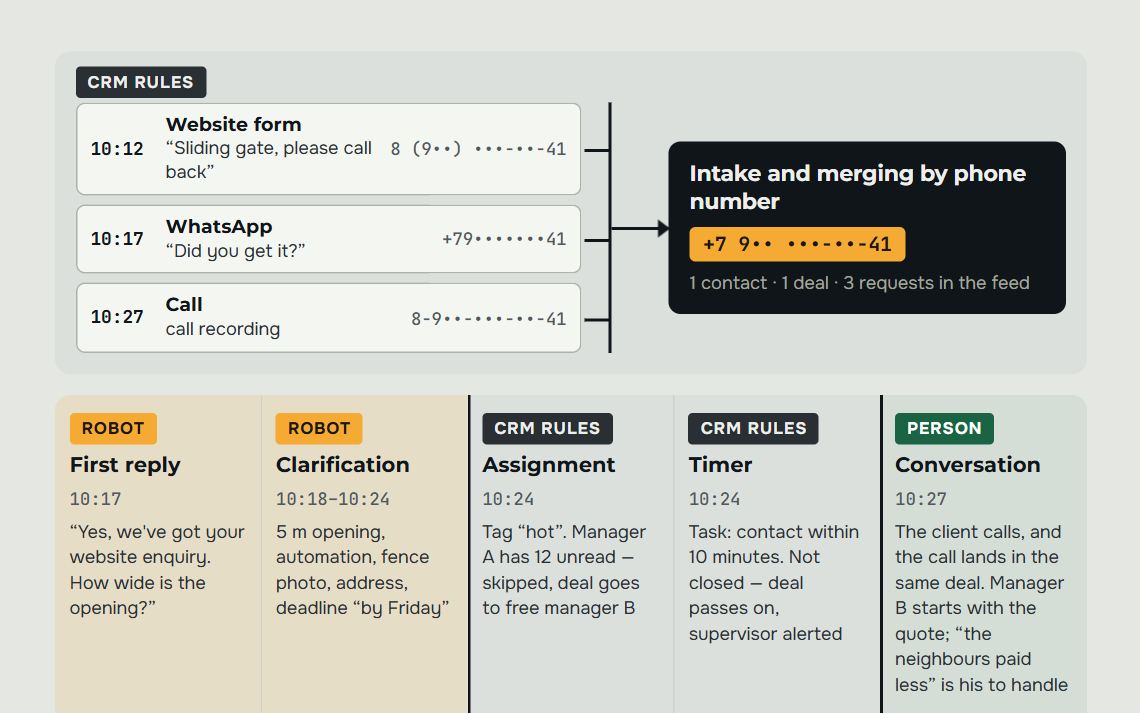
When there are dozens of enquiries a day, the manager opens them in order of arrival: in the general list they all look the same. While they sort through empty requests, someone ready to buy today is cooling off right next to them. So filtering and labelling must happen before the enquiry reaches the manager.
A junk enquiry is one with nothing to act on: no contact, no request, a mistake, an ad, a job seeker or a supplier. “Just checking prices” doesn't belong here; that's a cold client. If you lump cold leads together with junk, the filter will start throwing out future buyers, and the reports won't show it.
Filtering with a form full of required fields is a bad idea: it cuts people off before they get interested and loses good enquiries along with bad ones. The robot asks the same questions within the conversation, and only the missing ones. If the client has already said what they need, there's no point asking again.
Labelling is a hint, not a verdict: enquiries only change their place in the list and never disappear. Once a day, skim what ended up in low priority. If live clients regularly turn up there, the rules need changing. And bring all channels into one CRM: otherwise a person who wrote in three channels looks like three enquiries with three managers.
Labelling at the entrance solves half the problem. A hot lead can also get lost with the manager if they saw the label but postponed the call. That's why hot enquiries get a first-response timer, and quality control checks in chats and calls whether the manager reacted as agreed.
Mistakes that make qualification scare clients off
Interrogation instead of conversation. The framework gets copied into the chat wholesale, and the client receives six questions in a row without a single answer to their own. The person wrote to find out the price and leaves feeling interrogated. Alternate: an answer to the client's question, then your question, then something useful for them again.
Judging by a single sign. “No budget means cold” sounds logical until a client with a small budget turns out to be ready for a measurement tomorrow. The reverse story: someone names a large sum but is building a year from now. Temperature adds up from several signs, and one strong answer doesn't decide it.
No step for “not now”. The client gets marked as cold and forgotten. Two months later they buy from a company that reached out to them first. Every lead with a warm or cold temperature should have a dated task, otherwise qualification just sorts your losses.
The manager asks the same questions again. The robot has already found out the timing and the area, and the manager opens the call with “Tell me what you're interested in.” The client answers a second time and gets annoyed. Agree that before a call the manager reads the card fields and starts from what is already known.
The qualification scheme on one page: where to start
Start on paper and bring in the robot later. A scheme you can't explain to a new manager in five minutes can't be explained to a robot either. Here's the order of steps:
- write down the criteria that set buyers apart from those who said no;
- describe hot, warm and cold in a sentence or two;
- phrase your questions so each one gives the client something in return;
- set up fields and stages in amoCRM for these signs;
- launch the robot on one channel and read the first twenty conversations in full;
- after a month, check how many of the hot leads actually bought, and adjust the rules.
The last step matters more than the rest. The scheme lives with the market: in spring, “before the cold” sounds relaxed; in October it means “urgent”. Review the rules once a season using facts from the CRM, and qualification will help you sell, not just sort leads by colour.
Frequently asked questions.
How is lead qualification different from filtering out junk leads?
Screening removes what isn't an enquiry at all: spam, wrong numbers, job seekers, suppliers. Qualification works with real clients and decides how ready each one is to buy.
After filtering, you're left with people who have a real interest. Qualification sorts them by temperature: whom to call now, whom to send a quote and follow up with in a week, whom to nurture with useful materials until spring.
What questions should you ask a client to qualify a lead?
A basic set for a small business: what is needed, by when, where the property or client is, who else is involved in the decision, and what price range is being considered.
Ask them one at a time and explain each time why you're asking: “Let me check the width so I can calculate it precisely.” If the client has already answered some of the questions in their first message, don't repeat them.
Can you ask the client about budget right away?
You can, if the question helps the client rather than tests them. A blunt “What's your budget?” in the first message often sounds like sizing up their wallet.
It's safer to offer a choice: “Are you looking at an option with automation, or without for now?”, “Do you need the budget version or one with finishing?” The answer shows the ballpark figure, and the client feels a solution is being tailored to them.
How many criteria do you need to consider a lead hot?
Two or three key signs are usually enough, the ones that set your buyers apart from those who said no. Most often it's a clear task, a near deadline and agreement to the next step: a measurement, a meeting, an invoice.
Marking a lead hot on a single criterion is risky. A big budget with no timeline, or urgency outside your service area, looks attractive, but such leads rarely make it to a deal.
Can the robot get a lead's temperature wrong?
It can, especially if the rules are vague. The robot follows the scheme you gave it, and if the scheme doesn't say what to do with a client who has no deadline, the decision will be random.
So read the first conversations in full and check the temperature against your own judgement. Turn disputed cases into new rules. A manager who receives a hot client can also correct the temperature in the amoCRM card.
What should you do with cold leads after qualification?
Give them a next step with a date. Cold today often means “not now”, and a couple of months later such a client buys from whoever reminded them they exist.
Ask when to pick up the conversation again and set a task for that day. Send those with no timeline useful materials on the topic. Close the clearly irrelevant ones, such as clients outside your service area, with a clear reason for the rejection.
Let's audit your business
Leave a request and on a free consultation we'll find where customers are being lost, suggest which service to start with and price it around your goal.
Rather not fill in a form? Message our agent on Telegram — it replies right away and books you a review.