Sales scripts for salespeople: how to build and check them
A sales script for your team has five blocks: a greeting with a reason for the call, questions about the client's task, a pitch built on the client's answers, responses to common objections and agreement on the next step. Build it from recordings of your best conversations, have people learn what each block is for rather than the text, and update it when the same objection keeps coming up.
Why a sales team needs scripts if the reps already know how to talk
Monday, 11:20. A new rep calls a lead about glazing a balcony. The client asks: “So how is your frame different from what they're putting in at the development next door?” The rep is silent for a couple of seconds, then promises to find out and call back. The experienced colleague at the next desk would have answered straight away, but his answer lives only in his head.
A sales script moves answers like that out of your best seller's head and into a shared document. It spells out how to open the conversation, which questions to ask, how to explain the price and what to agree on at the end. A newcomer goes into calls with something to lean on, and the head of sales gets a standard to listen to conversations against and to review mistakes with.
Sales scripts for reps often get written and then filed away because “reading off a sheet doesn't work.” That's true if the sheet is read out. Within three sentences the client hears a memorized text: a flat tone, questions fired off like a list, and the rep answers the client's remark with the next item. The person stops talking and starts defending themselves.
A working script is built like a map. It has the must-hit points of the conversation and a few proven phrasings for each, while the rep picks the order and the words to suit the person on the line. What needs to be learned is the purpose of each block. Then the script helps on the third call and on the three-hundredth.
Greeting, reason for the call and finding out what the client needs
A script is split into five blocks: greeting and reason for the call, finding out the task, a pitch built around the task, handling objections, and closing on the next step. Each block answers one of the client's questions: who are you, did you understand me, why does this suit me, what about my doubts, and what happens next.
“Anna, good afternoon, my name is Sergey, I’m calling about your request for balcony glazing. Do you have a couple of minutes to talk?”
“Do you want the balcony insulated or unheated?”
“So it’s important that it’s warm in winter and there are no draughts?”
“You said a child will be sleeping there, so I’d suggest…”
“Too expensive” → “I get it. What are you comparing it with?”
“I need to think about it” → “What do you want to weigh up — the price, the timing or the option itself?”
“Let me book the surveyor for Thursday. Is morning or evening better for you?”
Hypothetical example based on a balcony glazing request; the wording is taken from the article. The card's five boxes are the checklist items from the section on checking. In the call shown, the rep skipped the last point and ended the conversation with “Just call us if anything comes up.”
The greeting takes one or two sentences and names the reason right away. The client left the request an hour ago and has already forgotten on which website. Here's what works: “Hi Anna, this is Sergey, I'm calling about your request for balcony glazing. Have you got a couple of minutes to talk?” Name, reason and a question about timing, with no story about the company.
Finding out the task is underrated more often than any other block. The rep wants to talk about the product right away and misses the moment when the client is ready to explain what they need. Put three to five questions in the script that the offer depends on: “Do you want the balcony insulated or unheated?”, “What are you planning to use it for?”, “When does it need to be done by?”
Ask the questions one at a time and respond to what you hear. The client says: “We want to turn it into a kids' room.” A weak rep moves on to the next item on the list. A strong one checks: “So it matters that it's warm in winter and there are no drafts?” The client hears that they've been understood and opens up more readily.
Pitch, objections and agreeing on the next step
Build the pitch from the client's answers. If they said “kids' room,” talk about the insulated frame, floor insulation and windows that won't fog up. Say nothing about panoramic glazing and designer hardware until they ask. A good bridge sounds like this: “You mentioned your child will be sleeping there, so I'd suggest…”
Keep two or three bridges like this in the script for the typical tasks of each product. The rep just picks the right one and drops in the client's own words. The pitch comes out short, and every line of it answers what the person said a minute ago.
Write objections down in pairs: the client's line and an answer that has already worked for your salespeople. For “too expensive,” this works: “I get it. What are you comparing it with? If it's cold glazing, the difference is exactly the insulation — without it, in winter it'll feel like being outdoors.” For “I need to think about it”: “Of course. What do you want to weigh up — the price, the timing or the option itself?”
The close is an agreement on a specific step with a date. “Just call us if anything comes up” has no place in the script. This does: “Let me book a surveyor for Thursday. Is morning or evening better for you?” If the client isn't ready, make the step smaller: “I'll send you the quote on WhatsApp today and give you a ring tomorrow at lunchtime to go over it. Does that work?” That step immediately becomes a task in amoCRM or Bitrix24.
All the script blocks in one table: easy to print and keep next to the phone.
| Script block | What the block does | Example phrase |
|---|---|---|
| Greeting and reason for the call | Answer the client’s question “who are you and why are you calling” | “Anna, good afternoon, my name is Sergey, I’m calling about your request for balcony glazing. Do you have a couple of minutes to talk?” |
| Finding out the task | Understand what the client needs and show you heard them | “So it’s important that it’s warm in winter and there are no draughts?” |
| Pitch tailored to the need | Link the offer to what the client said a minute ago | “You said a child will be sleeping there, so I’d suggest…” |
| Handling objections | Find out what lies behind the doubt and answer it head-on | “Of course. What would you like to weigh up: the price, the timing or the option itself?” |
| Closing on the next step | Agree on a specific action with a date | “Let me book the surveyor for Thursday. Is morning or evening better for you?” |
| Silence in a messenger | Bring back a client who read the message and didn’t reply | “Anna, I’ve prepared two options for the nursery. Shall I send them here?” |
A script built from your best conversations, not dreamed up at a desk
A script the head of sales invents at a desk usually sounds smooth and sells badly. It's full of textbook phrasing that clients in your niche never use and don't respond to. It's more reliable to take recordings of calls and chats where a deal went through and find what already works in them.
Here's how. Export ten closed deals from the CRM and the same number of lost ones. Listen to the first conversations and write down how your best rep opens a call, what questions they ask and how they answer “too expensive.” Then compare with the lost deals: where the conversation went off track and what line was missing there.
An example from one such review. Asked “Why does it take so long, three weeks?”, the best seller answers: “We cut the frame to fit your opening — we don't take a ready-made one off the shelf. That way you won't have gaps you'd have to foam over later.” Newcomers answer the same question by apologizing and promising to “hurry up production.” The best seller's wording goes into the script almost word for word.
Write in your reps' own language, in short sentences that are easy to say out loud. Read every line aloud: if you run out of breath halfway through, cut it. Give the finished draft to two experienced salespeople. They'll quickly flag the places where nobody talks like that in real life.
Calls and messengers: two different scripts
A call script rests on voice and pace. The client can't see the text, but they hear the pauses and the confidence. You can ask questions one after another because the answer comes right away. The conversation happens in one go, and the close on the next step comes in the same call.
In chat, it's a different story. Wednesday, 7:40 p.m., a client writes on WhatsApp: “How much to glaze a three-meter balcony?” If you reply with a call script — a three-line greeting and a counter-question about their task — the person will go to whoever named a price.
In a messenger, you answer the client's question first, even if only with a price range, and only then ask one of your own: “It usually starts at around such-and-such. I can be more precise if you tell me: do you want the balcony insulated or unheated?” One question per message, and each one explains why you're asking.
Chats drag on longer. The client reads with gaps, forwards the quote to his wife, comes back a day later. So add a block on silence to your messenger script: what to write if a message was read and left unanswered. For example: “Anna, I've put together two options for the kids' room — shall I send them here?” Also cover how to respond to a photo of the opening or a long voice message.
A chat script is easy to hand over to a robot: it answers by the same rules on Telegram, WhatsApp and Avito at any time of day or night. In a live GetGate project, 27% of leads came in during evenings and weekends, and they used to wait until morning. For a flow like that, the written script becomes a direct instruction for the robot.
Follow-up script: what to write to a client who didn't buy straight away
The most common drop-off point is a client who got a quote and went silent. Without rules they are either forgotten for a month or remembered all at once and sent three messages in a row across different channels. Both burn the client. So the script needs a separate block: the rhythm of touches and a reason for each one.
The rhythm is simple. On the same day, a wrap-up: thanks for the conversation and the promised quote. A couple of days later, a call with a direct question: has there been time to look, and what is still unclear. If there's silence, switch channels: if you called, write; if you wrote, call. Make the next touch with a new reason. The intervals depend on the deal cycle: where decisions take a week, the rhythm is tighter.
A reason is something new for the client: an answer to their question, an example of similar work, changed terms. “Just wanted to remind you about us” is a pretext, and it reads as spam. The test: the message is useful even if the client never buys. The texts depend on where the client went silent.
| Where the client went silent | What the touch is about | Sample text |
|---|---|---|
| After a quote or proposal | About the content of the offer, not about whether it arrived | “Have you looked at the price and scope of work? What needs clarifying — timing, volume or something else?” |
| After a site measurement or demo | About the question the client asked in person | “You asked whether the windows would fog up. Here is a short answer and an example of a similar balcony” |
| After a conversation without a price | About the conversation's outcome and the next step | “I noted that it matters to you to finish before the cold weather. Shall I send an option for that deadline?” |
| After two or three touches without a reply | An honest question whether to continue | “Is this still relevant for you? If not, just let me know and I won't bother you” |
It's time to stop when the client hasn't replied to two or three touches in different channels, has written “I'll get in touch myself” or has blocked the chat. The last message in the table gives them the right to say “no” without awkwardness. Some clients reply that they were simply busy. Move the rest to “not ready now” and write to them only when there's a new reason.
Keeping the rhythm across dozens of deals is hard for a manager, so the CRM holds it: after each touch it creates the task for the next one. The robot handles reminders and puts the specific deal's details into the text. In a large deal, the decision whether to write to this client and about what stays with the manager.
Checking: a checklist, spot-listening or speech analytics
A script works as long as people actually use it. A month after rollout, reps quietly slip back into old habits: they skip the questions about the task and forget the next step. You need to check regularly, and there are three ways to do it.
A checklist is a short list of the script's must-hit points, each answered “yes” or “no”: named the reason for the call, asked about the task, tied the offer to the client's answer, handled the objection, agreed on a step with a date. Five to seven items are enough. Nobody honestly fills in a twenty-item checklist.
Spot-listening: the head of sales takes a few conversations from each rep and scores them against the checklist. It's simple, but it runs up against time. You can review a dozen recordings a week, but not a hundred. On top of that, the sample is random, and a lost deal can easily slip past.
Speech analytics removes that limit. AI transcribes every call and reads every chat, scores them against your checklist and shows the head of sales the questionable cases with a quote from the conversation. That's the idea behind our quality control. Standards and how to go over the results with your reps are covered in detail in the article on checking your salespeople.
Recurring objections are a reason to rewrite the script
A script ages along with the market. A competitor cuts prices, a new model comes out, clients start asking about installments. If three reps heard the same objection in one week and each answered it their own way, your script has a hole.
Keep a simple list: the client's line, how many times it came up in a month, and how the conversation ended. Done by hand, it's compiled from recordings before the team meeting. Speech analytics keeps the list on its own: it tags objections in every conversation and groups similar ones. “Too expensive,” “the neighbors got it cheaper” and “a bit pricey for us” become one line.
Once a month, take the three most common objections and look for conversations where they were answered well: the client stayed in the conversation and agreed to the next step. Move the wording from that conversation into the script and drop the old one. For a couple of weeks, use the checklist to see how the new answer takes hold across the team.
“We cut the frame to fit your opening — we don't take a ready-made one off the shelf. That way you won't have gaps you'd have to foam over later.”
Hypothetical example: how many times each line came up is made up. The lines themselves and the best seller's answer are taken from the article. Speech analytics keeps a list like this on its own and merges similar objections into one line.
Deal separately with objections caused by your own mistakes: a missed deadline, a wrong price in a listing. There, the client first needs an apology, and it follows its own rules. We've collected them in our article on apology scripts for customers.
Where to start: the first version of your script
Take one channel and the one product that sells most often. The full set of scenarios can wait. Here's the order:
- pick ten successful conversations and ten lost ones for that product;
- from the successful ones, write down phrasings for the five blocks: reason for the call, questions, pitch bridges, answers to objections, next step;
- put together a one- to two-page draft and read it aloud with an experienced salesperson;
- make a short version for WhatsApp and Telegram;
- draw up a five-to-seven-item checklist and after a couple of weeks check conversations against it;
- update the answers to the most common objections once a month.
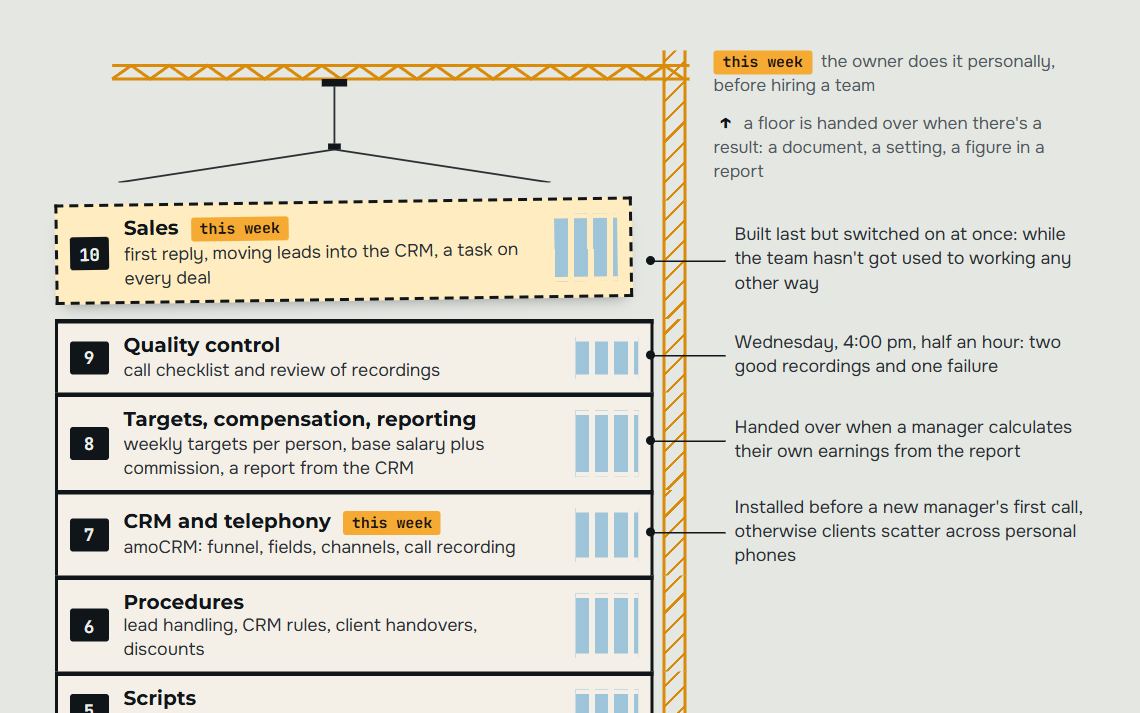
A script works hand in hand with your procedures, your CRM and onboarding for new hires. That's handled by our service for building a sales department: scripts and procedures, analysis of deals and reasons for lost sales, a next step for every lead, and onboarding new salespeople.
You can tell the script has taken hold when you review calls. A newcomer handles “too expensive” as calmly as your best seller. And at team meetings people argue about wording, and nobody asks “why do we need a script” anymore.
Frequently asked questions.
Do reps need to learn the sales script by heart?
By heart, they only need the purpose of the blocks and a few key lines: the reason for the call, the answer to “too expensive,” the wording of the next step. Everything else the rep says in their own words.
The client hears a memorized text from the first lines and starts to shut down. It's more reliable to practice the script in pairs: one plays a client with objections, the other responds. After a few of these sessions the phrasing becomes their own and sounds natural.
Can you use one script for both calls and WhatsApp?
The blocks are shared, but it's better to keep the wording separate. On a call you can ask several questions in a row and agree on a step right away.
In a chat, the client is waiting for an answer to their question, so you first give at least a price range and only then ask. Messages are shorter, one question at a time, plus a separate block for when the client has read the message and gone quiet.
Who should write the sales script: the head of sales or the reps themselves?
The head of sales puts it together, and the best reps supply the wording. The head knows which steps are mandatory and what needs to be found out from the client.
The words clients respond to are in the recordings of strong sellers' successful conversations. It's worth reading the finished draft aloud with the team: reps will immediately point out lines nobody actually says and suggest their own, proven on the job.
How often should you update a sales script?
Review the answers to objections once a month, and the whole script whenever the product, the prices or your main lead channel changes.
The signal for an unscheduled update is simple: the same objection comes up for several reps, and each answers it their own way. Find the conversation where the answer worked, move the wording into the script and use the checklist for a couple of weeks to see how it takes hold.
What if a rep doesn't want to work from the script?
First find out why. Often the script is written in a language nobody actually speaks, and an experienced seller gets by without it.
Invite the rep to co-author it and add their best lines to the script. If they sell well, check only the mandatory points on the checklist. If the results are weak, go through the recordings of their calls together.
How many times should you write to a client who doesn't reply?
There is no universal number: it depends on the deal cycle and the amount. Count touches that have a reason. An empty “what do you think of our offer?” can be sent once; a touch with new information is fine as long as the client responds.
If two or three touches in different channels got no reply, ask directly whether the question is still relevant, and from then on write only when there's a new reason.
Let's audit your business
Leave a request and on a free consultation we'll find where customers are being lost, suggest which service to start with and price it around your goal.
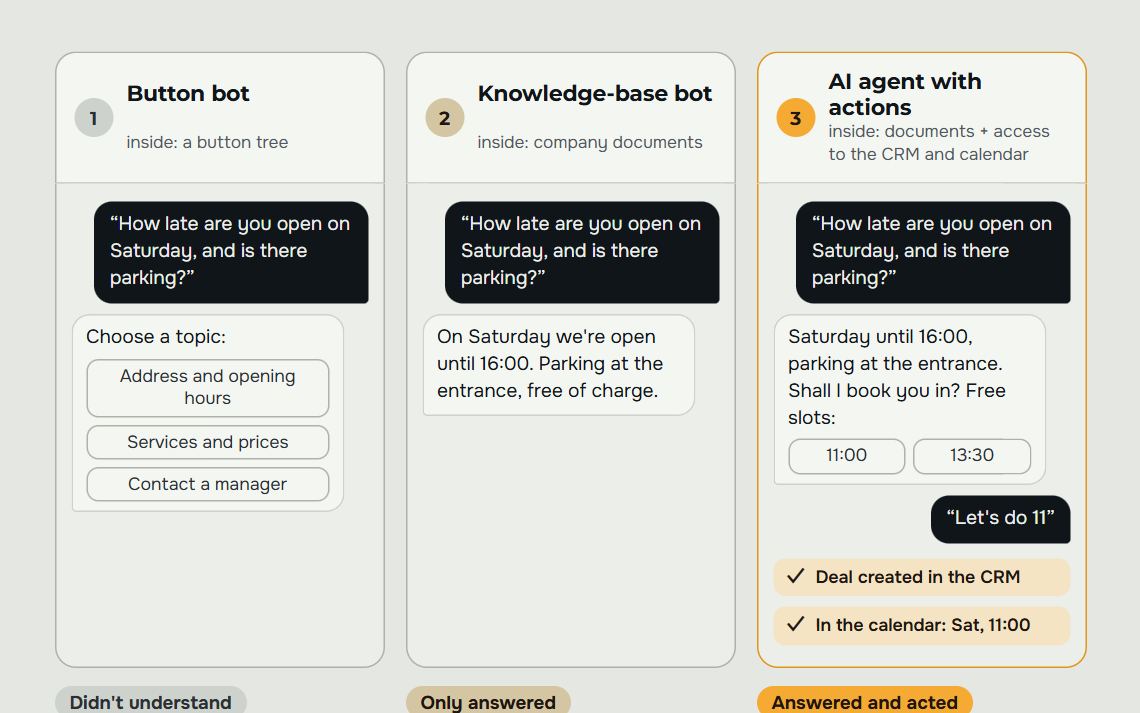
Rather not fill in a form? Message our agent on Telegram — it replies right away and books you a review.