How to build a sales team from scratch: 10 steps
A sales team built from scratch is put together in order: goals and sales model, funnel, roles, hiring, scripts, procedures, CRM with telephony, targets and compensation, call control, automation. Each step has a result you can check. People are hired once the process is described, and the CRM goes in before the first call.
Building a sales team step by step: what needs to be ready
A sales team is assembled in order. First you decide what you sell and to whom, then you describe the customer's path, and only then do you hire people. If the order is broken, a new manager asks on their very first Monday: “So what do I say, and where do I record everything?” The company has no answer.
Each step below has a result you can show: a document, a setting, a figure in a report. No result means the step isn't done.
| Step | What we do | Done when |
|---|---|---|
| 1. Goals and sales model | Revenue goal, average deal size, deal path, who sells | The model and the quarterly goal are written on one page |
| 2. Funnel and stages | Stages from lead to payment and repeat purchase | Every stage has an exit condition that's clear without explanation |
| 3. Roles | Splitting the work between hunter, farmer and head of sales | Each role has a written area of responsibility and a key metric |
| 4. Hiring and onboarding | Candidate profile, role-play, plan for the first weeks | A newcomer takes a lead to the next step on their own and fills in the card correctly |
| 5. Scripts | First reply, questions, objections, agreeing on the next step | The script has been tested on recordings of real calls and corrected |
| 6. Procedures | Response times, CRM rules, client handovers, discounts | A manager finds the answer in the procedure instead of going to the head of sales |
| 7. CRM and telephony | amoCRM, funnel, fields, channels, call recording | A lead from any channel lands in a deal automatically |
| 8. Targets, compensation, reporting | Targets per person and per week, base salary plus commission, a report from the CRM | A manager calculates their own earnings from the report |
| 9. Quality control | Call checklist, listening, review | Every manager's calls are reviewed every week |
| 10. Automation | First reply, moving leads into the CRM, tasks | No lead sits without an owner and a task |
If the team is already up and running but selling below expectations, you don't need to start from scratch. First run a sales team audit: it will show which steps from the table have been skipped.
The steps and results come from the table at the start of the article. The “this week” label marks the five tasks from the last section that the owner does personally before hiring: model, funnel, roles, CRM with business numbers, automatic first reply.
Step 1. Sales team goals and sales model
Start with the amount the team should bring in and with how customers buy from you. The sales model answers four questions: who the customer is, where they come from, how many touches it takes to get to payment and who runs the deal.
Short cycle: a buyer writes “Still available?” on Avito, finds out the price and pays the same day. Long cycle: a factory buyer asks for a commercial proposal, agrees it with an engineer and pays a month later. The first business needs a fast reply and a steady flow of leads; the second needs an experienced person for every client.
Then work backwards. Divide the revenue goal by the average deal size and you get the number of deals. Divide the number of deals by the lead-to-payment conversion rate and you get how many leads you need. If you have no conversion data of your own, treat the first weeks of work as a measurement and recalculate.
Done when the client, channels, deal path, quarterly goal and lead calculation are written on one page.
Step 2. Sales funnel: stages and exit conditions
The funnel is the set of stages every deal goes through. A small company starting out needs six or seven: new lead, qualification, meeting or estimate, commercial proposal, approval, payment, repeat sale.
The key thing in a funnel is the exit condition. The “Qualification” stage is passed when the client's task, budget, timeline and decision-maker are known. The “Quote sent” stage is closed when the file is in the deal card and a call date is set. Without such conditions, managers move deals by gut feeling, and the report shows mood, not money.
Stages and reasons for loss are from the article. Exit conditions for “Qualification” and “Quote sent” are also from the article; for the other stages they're sample wording. The factory buyer is the long-cycle example from step one.
Write down the reasons for loss as a list too: too expensive, off-season, chose another supplier, stopped responding. In a couple of months this list will show where you lose clients. More on stages and conversion in our article on the sales funnel.
Done when any employee understands from the stage name what has been done with the deal and what comes next.
Step 3. Roles in a sales team: hunter, farmer and head of sales
In a small team one person often does everything: answers leads, looks for new clients, looks after existing ones. As the flow grows, regular clients stop getting calls and new ones wait until evening for a reply. Split the work into roles, even if one person still covers them all for now.
| Role | Area of responsibility | Key metric |
|---|---|---|
| Owner | Sales model, goals, budget, approving compensation | Revenue and profit for the quarter |
| Head of sales (runs the sales team) | Targets, hiring, training, reviewing deals and calls | Team plan fulfilment, conversion by funnel stage |
| Hunter (new business) | New clients: inbound leads, cold calls, first deal | Number of first payments and revenue from new clients |
| Farmer (account manager) | Repeat sales, upsells, retaining regular clients | Revenue from repeat deals, share of clients lost |
| Front-line manager | First reply, qualification, booking a meeting or a call with the hunter | Time to first reply, share of leads that reach a meeting |
In a new team the head of sales often sells personally: it's faster. Treat it as a temporary measure. Their job is to make others sell. If the head of sales closes most of the deals, you have a one-seller team with assistants.
Areas of responsibility and metrics come from the roles table in the article; commission on the result of one's own role comes from the compensation step. The client's message is the example from the automation step.
Done when each role has a written responsibility and one metric.
Step 4. Hiring and onboarding sales managers
Hire for a role from step 3. A hunter needs drive and a calm attitude to rejection. A farmer needs patience, accuracy and a memory for client details.
Give a short role-play in the interview. You're the client and write on WhatsApp: “A bit pricey. Others are cheaper.” Watch what the candidate does: gives a discount right away, starts arguing or asks what the client is comparing with. One such scene will tell you more about a person than a CV.
Screening applications and the first questions to candidates can be handed to a robot; the hiring decision stays with you. More in our article on automating recruitment.
Plan onboarding day by day. Week one: the product, the funnel, the CRM, the best calls from the archive. Week two: calls under the head of sales' supervision and a short review every evening. After that, independent work with a weekly check.
Done when a newcomer, without prompting, takes a lead from the first reply to the next step and fills in the card correctly.
Steps 5 and 6. Sales scripts and team procedures
Scripts: what to say to the client
A script sets a common minimum: how to greet, what to ask, how to respond to “too expensive” and “I'll think about it”, how to agree on the next step. Reading it word for word isn't required. Going through every block is.
Write the script from real conversations: record the first calls, note down the clients' questions and the answers that worked, build blocks from them. After a couple of weeks, listen again and cut what's unnecessary. Ready-made blocks and sample phrases are in our article on sales scripts.
Procedures: rules you don't have to explain out loud
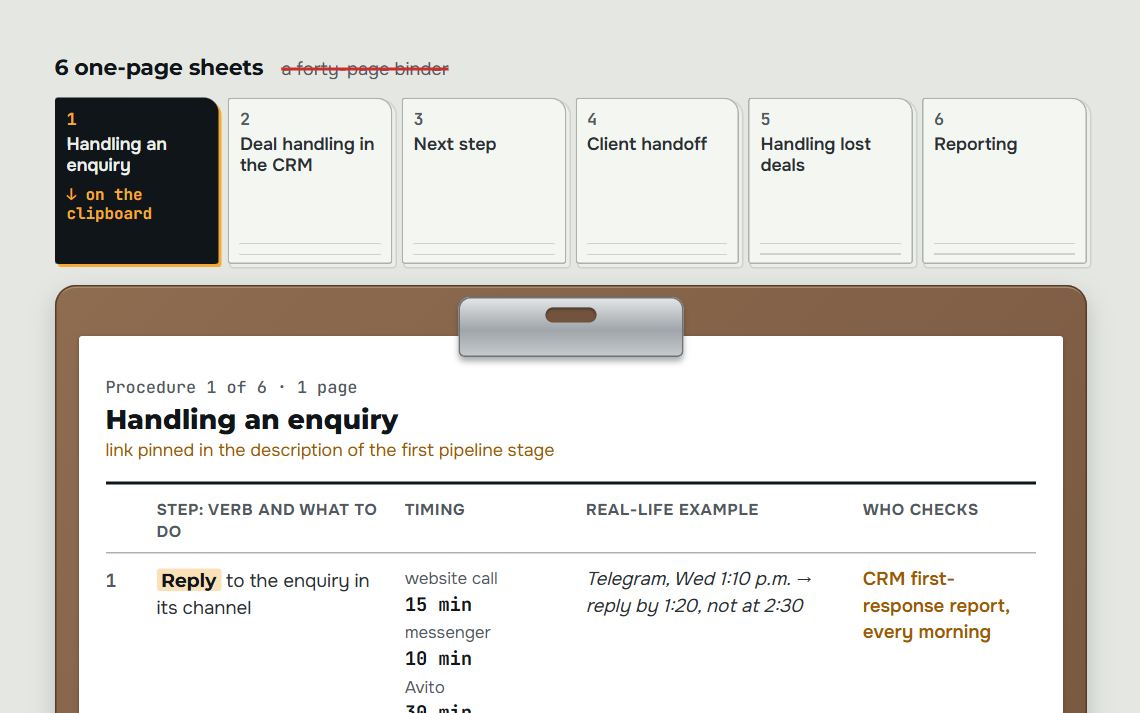
A procedure answers the questions that would otherwise be put to the head of sales ten times a day. How quickly we reply to a lead. Which fields must be filled in on the card. Whom to hand a client to if the manager is on holiday. What to do if the client doesn't pick up.
At the start a few short documents are enough: lead handling, CRM rules, client handovers, discount rules. Each one or two pages long. How to write them is covered in our article on sales team procedures.
Done when the script has been tested on call recordings, and a new manager finds answers in the procedures on their own.
Step 7. CRM and telephony for the sales team
Set up the CRM before a new manager's first call. If you start with a spreadsheet and a notebook, in a month clients will have scattered across personal phones, and you won't gather them back without losses.
For selling via calls and messengers, amoCRM is convenient: the funnel from step 2 carries over into it almost one to one. Bitrix24 is chosen when you also need documents and inventory in the same system. The setup matters more than the choice of system.
What must work from day one:
- a funnel with stages and required fields at each one;
- channels: website, phone, Telegram, WhatsApp, Avito — leads become deals immediately;
- telephony with call recording, calls visible in the client card;
- company business numbers and messenger accounts instead of managers' personal phones;
- merging duplicates by phone number: one client, one deal.
See how we set this up on our page on amoCRM implementation.
Done when in the morning, the head of sales opens the CRM and sees all of yesterday's leads, each with an owner, a stage and a next task.
The next-step rule: every deal has an action with a date
Deals stall, and laziness has nothing to do with it. A manager replied, sent a quote and switched to a new enquiry. Three days later the client is waiting for a call, and nobody remembers the promise. The card is open and counted in the forecast, but nobody is working on it. Memory fails exactly when enquiries pile up.
That's why from day one the CRM has two required fields: the next step and its date. Without them a deal can't move to the next pipeline stage. It's a system constraint, so nobody has to check it by hand. A step is always an action on your side. “Client is thinking” is not a step: there is nothing to do and nothing to miss. “Call on Thursday and ask about the decision on the quote” is a step.
The field doesn't replace tasks. A deal can have a dozen tasks or none, and their list won't tell you what is happening with the deal right now. The next step is always just one. A deal without it shows up in a single filter, while an overdue task drowns among others. So that managers don't invent a step every time, keep ready-made wording by stage at hand.
| Deal stage | Next step options |
|---|---|
| First contact | Call and find out the task; clarify budget and timing; send examples of work |
| Quote or proposal sent | Get on a call and discuss terms; ask which points are unclear; send an option with a different scope |
| Invoice issued | Remind about payment; check whether instalments are needed; find out the decision date |
| Payment received | Agree on the start date; send the contract; schedule a meeting on details |
Next you need escalation: if the step date has passed and the deal hasn't moved, the CRM creates a task and notifies the head of sales. The manager gets a morning list of cards instead of searching the whole pipeline. They watch two numbers: the share of open deals without a step and the share of overdue steps. Other companies' norms won't help here. If the share grows week after week, the process is falling apart.
If the team already works without this rule, start by measuring how many deals are sitting without a clear action. Then every new deal gets a step, and the old ones are sorted out one per day per manager. A couple of weeks later escalation is switched on, and later still the ban on moving stages without a step. Some old deals are more honestly closed as lost: they only distort the forecast.
Step 8. Sales targets, compensation and reporting
Take the target from the calculation in step 1 and break it down by manager and by week. A weekly target is more useful than a monthly one: mid-month is too late to find out the team is behind.
Compensation consists of a base salary the person lives on while learning, and commission on the result of their own role: the hunter for new clients, the farmer for repeat sales. If everyone gets a commission on any payment, the farmer will go off hunting for new clients, and regular clients will be left without attention.
The report builds itself in the CRM, with no manual spreadsheets on Fridays: leads, conversion by stage, revenue, overdue tasks. On Monday the head of sales opens it at the team meeting, and the conversation is about numbers.
Done when a manager knows their weekly target and calculates their pay from the report themselves.
Step 9. Quality control of calls and messages
While there are few calls, the head of sales listens to them personally. Take the checklist from the script: greeted, found out the task, named the price with a justification, agreed on the next step. Each item gets a “yes” or “no”.
Review calls every week with each manager, using their own recordings. Wednesday, 4:00 pm, half an hour: two good recordings, one failure and what should have been said differently. A review like this teaches faster than any training course.
Once there are more than two or three managers, the head of sales can listen to only a small share of calls. The rest is taken over by speech analytics, covered below.
Done when each manager has a weekly checklist score and a list of things to fix.
Step 10. What to automate in a sales team from day one
Three things are worth automating right away, before the team gets into the habit of working differently.
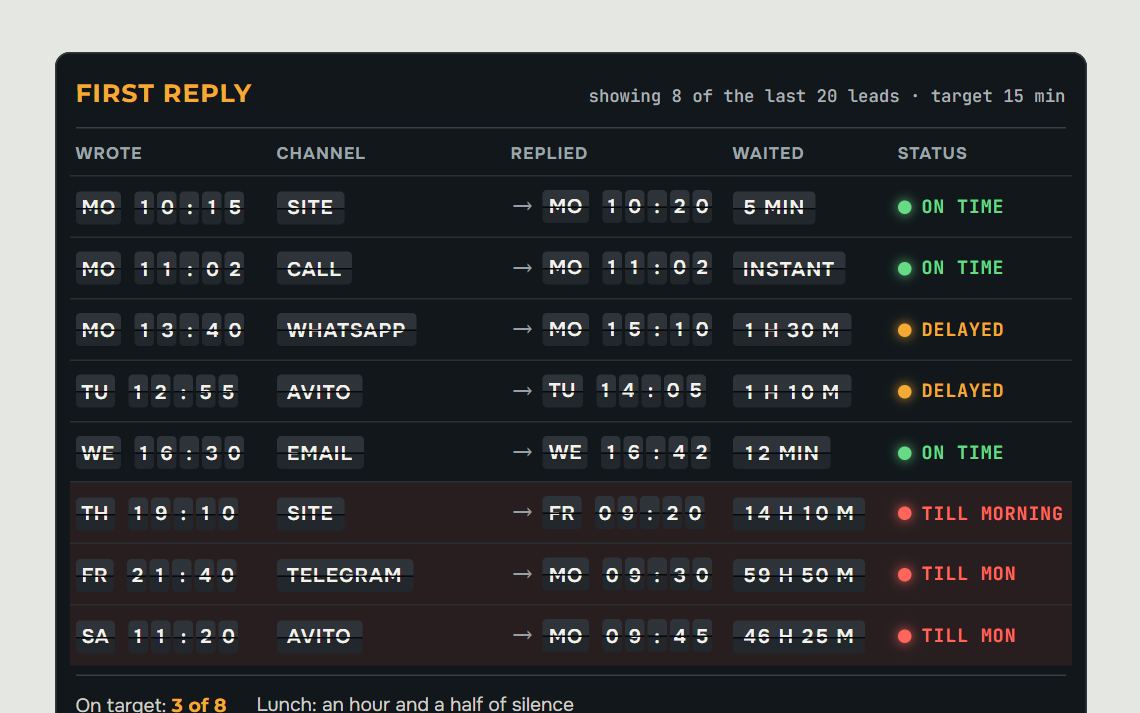
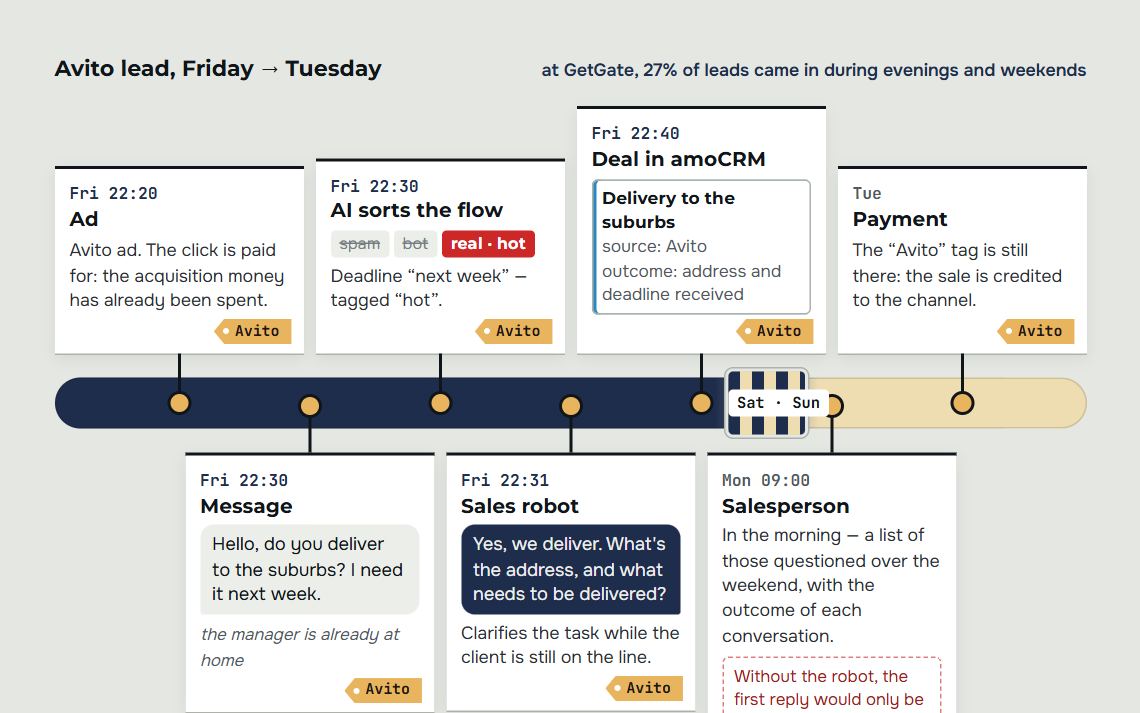
- The first reply. Friday, 9:40 pm, a client writes on Telegram: “How much is it and when can you come over?” If the reply comes on Monday, the client will already have made a deal with someone else. In an active GetGate project, 27% of leads came in during evenings and weekends, and all of them used to wait until morning.
- Moving leads into the CRM. A website form, a call, a message from Avito immediately become a deal tagged with its source. Nobody moves anything by hand.
- Tasks. Every deal has a task with a date. No task — the CRM creates one itself and notifies the head of sales. That way deals don't get stuck at the “Quote sent” stage.
Where AI takes over routine work in a new sales team
In a new team, AI takes routine work off people's hands in three places where there's a lot of repetitive work.
First reply at any hour
A sales robot replies on Telegram, WhatsApp, Avito and the website according to your price list and rules. It understands voice messages and photos and hands a hot client over to a manager with a short summary. We ran a blind comparison on real conversations: in 80% of cases, the assistant's reply was rated no worse than a human's.
Lead qualification
The robot asks the same questions that are written into the exit condition from step 2: task, timeline, budget, who decides. It writes the answers into the card fields in amoCRM. The manager can see right away whether to call now or tomorrow.
Review of calls and messages
AI listens to every call and reads every chat, scores the conversation against your checklist and flags deals the manager has missed. The head of sales gets a list of conversations worth looking into instead of a hundred recordings in a row. AI also checks the conversation against the card: the field says “call on Thursday”, but the client was told “I'll ring you sometime this week”, which means there is no real agreement. More details on the page of quality control.
Decisions stay with people: haggling, complaints, large deals, hiring. Where else AI helps a company is covered in our overview of implementing AI in business.
Common mistakes when building a sales team
In 20 years in sales we've seen the same breakdowns in new teams again and again. A typical scene: Monday morning, the best manager quit on Friday. Along with him went the clients from his personal WhatsApp, and the CRM has nothing on them.
| Mistake | How it shows | How to fix it |
|---|---|---|
| People hired before the process was described | Everyone sells their own way, results depend on mood | Model, funnel and script first, hiring after |
| CRM put off until later | Leads in spreadsheets, notebooks and personal messengers | CRM and business numbers before the first call |
| Everything rests on one strong seller | He leaves and takes the clients with him | Messages and calls in the CRM, clients assigned to the company |
| The head of sales sells instead of managing | The team's target is met through his personal deals | Minimal personal target, most of the time on reviews and training |
| Compensation not tied to the role | Everyone chases quick payments, regular clients are forgotten | Commission on the metric of one's own role |
| Target without a funnel | The figure is handed down from above, nobody knows where the leads will come from | Calculate the target backwards from conversion and the number of leads |
| Nobody listens to the calls | The same mistakes for months, the script exists only on paper | Weekly review against the checklist |
Where to start building a sales team this week
The owner takes the first steps personally, before hiring a team:
- write down your sales model and quarterly goal on one page;
- draw the funnel and the exit conditions between stages;
- assign the roles, even if one person combines them for now;
- connect the CRM and business numbers before the first manager starts;
- set up an automatic first reply and lead transfer from all channels.
You can build this kind of system together with us through our “AI Head of Sales” service, designed to build the sales department. It includes scripts and procedures, reviews of deals and loss reasons, a next step for every lead and onboarding of new managers.
Frequently asked questions.
Where do you start when building a sales team from scratch?
With the sales model and the goal. Write down on one page who your client is, where they come from, how many touches it takes to get to payment and what revenue the team should bring in.
Then work backwards to how many deals and leads you need, and draw a funnel with exit conditions. Hiring people makes sense after that, when they have something to work by.
How many managers should you hire for a new sales team?
As many as needed to handle the projected flow of leads, and no more. The number comes from the calculation: revenue goal, average deal size, conversion.
At the start it's sensible to take on one or two people, test the script and funnel on them, and only then expand. The first reply at night and on weekends can be handed to a robot instead of a separate night shift.
Do you need a head of sales if the team has one or two managers?
The functions of a head of sales are needed from day one: targets, training, reviewing calls and deals. The owner or an experienced manager can perform them part-time.
A dedicated head of sales is usually hired when the owner no longer has time for the weekly review. The main thing is that the head of sales manages, and their personal sales don't replace the team's work.
Which CRM should you choose for a new sales team?
For selling via calls and messengers, amoCRM is convenient: the funnel carries over into it almost one to one, and Telegram, WhatsApp, Avito and telephony connect to deals.
Bitrix24 is chosen when you also need tasks, documents and inventory in one system. The setup matters more than the choice: required fields, call recording, merging duplicates and business numbers instead of personal ones.
Can you build a sales team on AI alone, without managers?
No. AI takes over routine work: it replies first at any hour, asks qualifying questions, moves leads into the CRM and reviews calls against a checklist.
Haggling, complaints, large deals and work with regular clients remain with people. The robot hands a hot client over to a manager with a short summary of the conversation, and the manager picks up from the same point.
What counts as a next step on a deal, and what doesn't?
A step is an action on your side with a date: “call on Thursday and ask about the decision”. “Client is thinking”, “waiting for a reply”, “under approval” are not steps but descriptions of a state: there is nothing to do and nothing to miss.
The test is simple: if the entry doesn't tell you what exactly you will do and when, it isn't a step. These are the cards that stall first.
Let's audit your business
Leave a request and on a free consultation we'll find where customers are being lost, suggest which service to start with and price it around your goal.
Rather not fill in a form? Message our agent on Telegram — it replies right away and books you a review.