Sales team audit: a step-by-step checklist
A sales team audit starts with the pipeline: you calculate the conversion rate at each stage and look for where it drops. Then you check response speed, after-hours leads, call recordings and chats, how well the CRM is filled in, and overdue tasks. Procedures, scripts, incentives and hiring come last: they explain where the gaps came from.
Why you need a sales team audit when you already have reports
A CRM report shows how many deals were closed. About clients who left without ever getting an answer, it says nothing. A sales team audit looks for exactly that gap: enquiries you paid for with advertising that vanished somewhere between the first message and the invoice.
The usual trigger looks like this. Monday, team meeting, the head of sales looks at the plan: more enquiries this month than last, but the same number of sales. Managers say “the leads have gone cold”. The marketer is sure the leads are fine. Without a proper review nobody can check who’s right.
An audit is worth doing in three cases. Sales are flat while the flow of leads is growing. New people have joined the team and results have started to slip. You're about to introduce a CRM, a robot or a new incentive scheme. In the last case the audit saves money: automation speeds up any process, including a broken one.
In brief: which areas the audit checks and what signs point to a problem.
| Area | What we check | Sign of a problem |
|---|---|---|
| Pipeline and conversion | How many deals reached each stage, broken down by channel and manager | A sharp drop at one stage; deals jump straight to payment |
| Speed of the first reply | Time from the client’s message to the first human reply, including lunchtime, evenings and weekends | Messenger messages wait for hours, evening enquiries until morning |
| Calls and chats | Conversations against a checklist: need, price, next step | The CRM says “client is thinking it over”, but on the recording the client asks for an invoice |
| CRM and tasks | Required fields, a dated task, overdue items, duplicates | Open deals with no task, piles of overdue items, one client with two managers |
| Reasons for refusal | Whether the recorded reason matches what was said in the conversation | “Too expensive” is the default reason, even though the client asked about instalments |
| Procedures and scripts | Whether managers describe the rules and answer common questions the same way | Three managers give three different answers to the same question |
| Motivation and hiring | What people are paid for and how a newcomer learns | The team does what it is paid for, not what the business needs; a newcomer learns by sitting next to a veteran |
How to tell your sales team is underperforming: a quick check
Problems show up before revenue drops. Before a full audit, check six signs; each takes about ten minutes. If three or more apply, the team is losing money right now, and the review below will show where exactly.
| Criterion | How to check |
|---|---|
| Enquiries get lost between channels | Ask three acquaintances to leave enquiries on the website, in a messenger and on Avito, and in the evening see how many of them are being worked on |
| The reply comes an hour or more later | Open the last five chats and compare the time of the client's message with the first reply |
| Nobody knows why clients say no | Ask the head of the team why clients turned down most often this month. The answer “price” without examples is also a sign |
| The CRM is only half filled in | Open ten closed deals: an empty loss reason or “not interested” in half of the cards |
| The plan lives with the manager in charge | Ask a manager to state their plan for the month, how much is done and how much is left, within a minute |
| Conversation quality is only visible at the end of the month | Recall when the head of sales last listened to calls without a client complaint |
At the same time, separate sales from marketing and product. If conversion from enquiry to first meeting or invoice has dropped, the problem is in sales: clients come, but they aren't followed through. If conversion is unchanged but there are few enquiries, it's a question for marketing. If people get as far as paying but there are many returns afterwards, look at the product.
Another sure sign: managers complain that “the clients are wrong”, but can't name the loss reasons for the last ten deals. Then the argument with the marketer is settled by the pipeline, covered in the next section.
The pipeline and stage-by-stage conversion
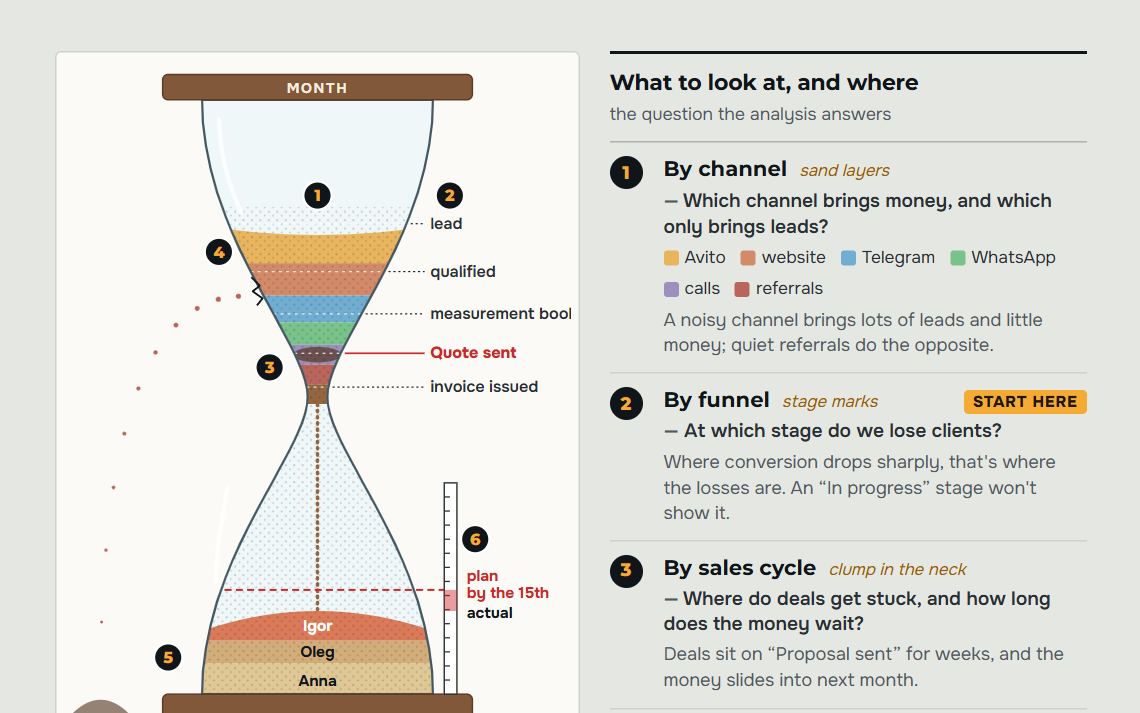
Start with the numbers you already have. Export the last three months of deals from amoCRM or Bitrix24 and count how many reached each stage: new lead, contact made, need identified, proposal sent, invoice issued, payment. Calculate conversion between adjacent stages.
Look at where the pipeline breaks off. If almost all leads get as far as a conversation but clients vanish once the proposal is sent, the problem is the proposal itself or the manager going quiet after sending it. If the drop is already at the first step, your team simply isn't getting through to clients by phone or by chat.
Break the pipeline down by channel and by manager as well. An example: in the overall picture, lead-to-invoice conversion looks tolerable. Broken down, you see that one manager closes Avito leads while the other lets them hang for weeks. The overall figure was hiding it.
Check the stages themselves too. Sometimes a pipeline has eleven statuses, managers use three of them, and the rest of the deals get dragged straight to “Won” on the day of payment. Then stage conversion can't be calculated, and that's already the audit's first finding.
First response speed and after-hours leads
Response speed can be checked with a simple experiment. Take the last twenty leads from different channels and write down two times for each: when the client wrote and when a person first replied. Both times are visible in the deal card: when it was created and the first outgoing message or call.
The picture is usually uneven. At 10:15, a website lead gets a call within five minutes. At 13:40, over lunch, a WhatsApp message waits an hour and a half. By then the client has written to three more companies and received two prices. They'll choose whoever replied first, and you'll never find out.
Leads that come in outside working hours deserve a separate look. Friday, 21:40, a client writes in Telegram: “How much will it cost if I need it by Wednesday?” The reply arrives on Monday at 9:30. In GetGate's live project, 27% of leads came in during evenings and weekends, and before, they sat waiting until morning. Work out this share for your own business.
Illustrative example, except for the rows from the article: 10:15 from the website, 13:40 on WhatsApp, and Friday 21:40 on Telegram. In the GetGate project, 27% of leads came in evenings and at weekends — work out this share for your business.
We covered in detail how to set a response-time standard and check it every day in the article on monitoring managers. For the audit, a measurement is enough: what share of leads got a quick reply and what share waited for hours.
Call recordings and chats: what's really being said
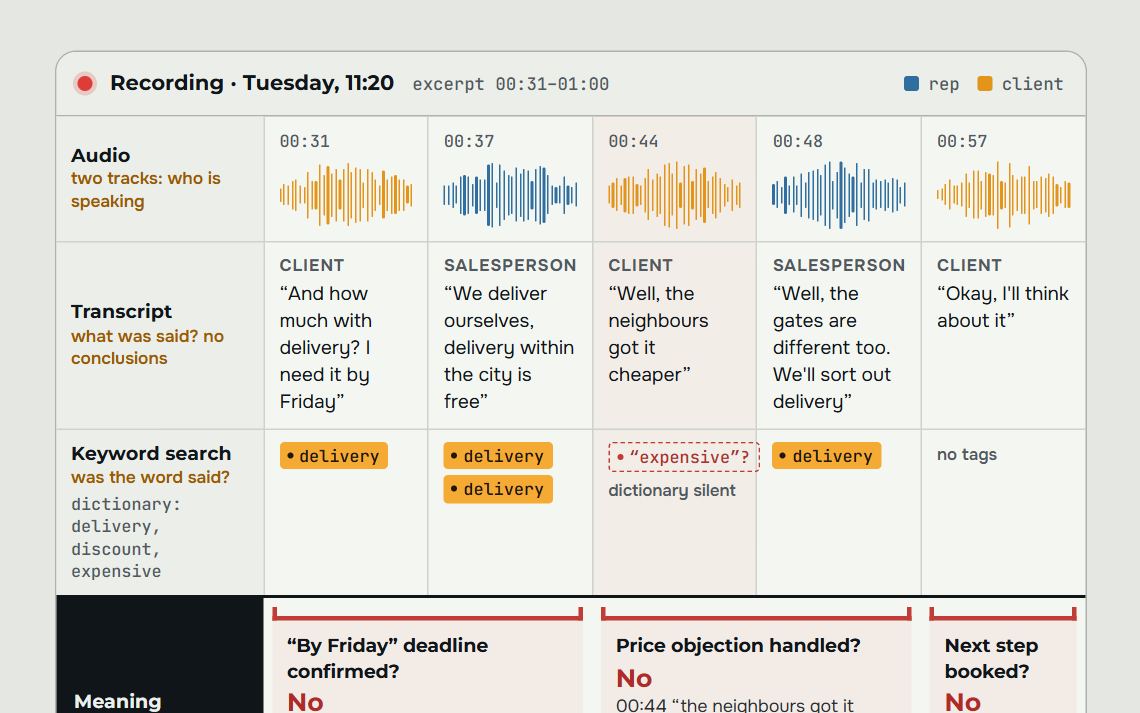
The deal card tells you what the manager reported about the conversation. The recording shows the conversation itself. Take five calls and chats from each manager: two closed deals and three losses. Listen and read with the checklist in hand: did they greet the client, find out what they need, name the price, agree on the next step.
A typical finding looks like this. In the CRM the deal status is “Client is thinking”. In the call recording the client says: “Fine, email me the invoice, I’ll pay by Friday.” The invoice never went out. Nobody sabotaged anything: the manager hung up, moved on to the next call and forgot.
In chats, look for questions left unanswered. A client on WhatsApp asks three times about delivery to the region, and the manager sends the price list three times. Look separately at lost deals: did the client really leave because of the price, as the reason field says, or did people simply stop following up?
Manual listening runs up against the head of sales' time: a dozen conversations a week is about all you can realistically review. When there are hundreds of calls and chats, AI takes over checking them against the checklist. That's the idea behind our quality control: it reviews every conversation, looks for lost deals and scores each manager.
CRM, tasks and overdue work
Open ten random deals and check three things. Are the required fields filled in: source, budget, need? Does the deal have a dated task for the next step? Is the communication history in the card, or does the conversation live on the manager’s personal phone?
A deal without a task is the most common sign of lost money. On Wednesday the client said: “Give me a call after my holiday, at the end of the month.” The manager replied “deal” and didn't set a task. A month later the client bought from someone who called on their own.
Then open the team’s task list and filter for overdue tasks. If there are hundreds, the team stopped working by tasks long ago and keeps the plan in their heads. Two things matter for the audit: how much is overdue in total and which managers it piles up with.
Another check is duplicates and deals with no one responsible. A client wrote in Telegram, then called, and two deals appeared in the CRM under two managers. The pipeline swells, conversion drops, and at the team meeting two people argue over whose client it is.
Rules, scripts, motivation and hiring
Ask three managers separately what they do with a lead when the client stops replying. Three different answers mean there is no procedure, even if a document with that title is sitting somewhere. Compare what it says with what you saw in the CRM: response times, the number of touches before giving up, the rules for handing over a deal.
Same with the script. Listen to how a newcomer and your best salesperson answer “Why are you more expensive?” If the best one answers confidently and the newcomer gets flustered, take the best one's wording and put it into the script. A good script is built from what already sells.
Put the pay scheme next to what the pipeline showed. A typical situation: the head of sales complains there are too few repeat sales, while a manager earns less for a repeat sale than for a new client. The team does exactly what it’s paid for. If the base salary is high and doesn’t depend on results, there’s no reason to rush to answer a late call.
With hiring, check a newcomer’s path: how many days pass from their first day to their first deal closed on their own, who trains them and with what materials. The answer “they sit next to an experienced colleague and listen” means every newcomer learns in their own way. High turnover in the first month usually points to training, less often to the people.
Where money usually gets lost
As a rule, money leaks out in five places. The first is a slow first reply, especially at lunchtime and after the office closes. The second is deals with no next step: the client agreed, but nobody scheduled a call or sent an invoice.
Third, lost deals nobody looked into. “Too expensive” gets set as the default reason, even though in the recording the client was asking about instalments. Fourth, repeat customers: they bought a year ago and nobody has written to them since. Fifth, leads from channels not connected to the CRM, such as a manager's personal WhatsApp or Instagram DMs.
All five spots have one thing in common: they don't show up in reports. A deal that isn't in the CRM doesn't exist as far as the report is concerned. A loss with the reason “too expensive” looks like an honest loss. That's why an audit starts with raw data — recordings, chats and deal cards — and only then looks at summaries.
A DIY sales team audit: six steps
You can quite realistically run the audit yourself if you set aside an hour or two a day for it. Go in order: each next step builds on the findings of the previous one.
Step one. Agree on what counts as an enquiry and put all channels on one list: website, phone, WhatsApp, Telegram, Avito, email. For each channel, find out whether the enquiry reaches the CRM on its own.
Step two. Export three months of your pipeline and calculate stage conversion by channel and by manager. Mark the two or three deepest drops.
Step three. Measure first-reply speed on twenty leads, including ones that came in at lunchtime, in the evening and on Saturday.
Step four. Listen to and read five conversations per manager. Look in them for the causes of the gaps you found in step two.
Step five. Check the CRM: fields, tasks, overdue items, duplicates. Then compare the procedures, script and incentives with what you've seen.
Step six. Put your findings into a table: the problem, where it shows up, how many deals it affects, who fixes it and by what date. Without that last column, the audit will remain a document nobody ever opens again.
Sales team audit checklist
Print the list and tick items off as you go. Every item answered “no” or “don't know” is a candidate for the fix plan.
- All enquiry channels are connected to the CRM; there are no personal numbers or chats outside the system.
- Conversion is calculated for every pipeline stage, broken down by channel and manager.
- Pipeline stages are used; deals don't jump straight to payment.
- There is a first-reply standard, and you know what share of leads meets it.
- Leads that come in at night, in the evening or on Sunday get a reply before morning.
- Calls are recorded, chats are stored in the deal card.
- Conversations are checked against the checklist regularly, not only when clients complain.
- Every open deal has a task with a date.
- There are few overdue tasks, and someone is responsible for each.
- Loss reasons are filled in and checked against call recordings.
- The sales rules set response times, the number of touches and deal handovers, and managers describe them the same way.
- The script is built from your best salespeople's wording and has been updated this year.
- The pay scheme rewards what the business needs: new clients, repeat sales, average order value.
- New hires have a training plan and recorded materials.
Hypothetical filled-in form. Items are shortened; the full text is in the checklist above.
Once you’ve gone through the list, you’ll want to hand some of the findings over to automation. Which tasks make sense to start with is covered in the article on sales department automation.
An outside view: what it adds
An internal audit runs up against habit. A head of sales who built the pipeline himself doesn't notice unnecessary stages: he remembers why each of them appeared. Managers blame the gaps on the market and the season. An outsider asks naive questions, and those are exactly what expose the problem.
An example of such a question: “Why do Avito enquiries go into a separate pipeline where nobody sets tasks?” Inside the team the answer sounds like “that’s just how it’s always been”. From the outside you see something else: a channel nobody is running.
The second thing an outside view gives you is comparison. Someone who has reviewed many sales teams quickly tells a gap that a procedure can fix from one that needs a CRM, a robot or new incentives. Scripts, procedures, lost-deal analysis and onboarding new hires are the work of our team for building a sales department.
AIBP starts with a free review: we look at your sales team and find where money is being lost. Then, if you decide to go ahead, we build the CRM, train the robot for your niche and connect the channels. After launch we compare plan against actual and fine-tune whatever is lagging.
Frequently asked questions.
How often should you audit your sales team?
A full audit makes sense every six months to a year, and every time something big changes: new managers join, you add a new channel, you switch CRM or change the pay scheme.
Between full audits, short checks are enough: first response time, overdue tasks, spot-listening to calls. If you look at these metrics every week, the big audit goes quickly and without nasty surprises.
Can you run an audit if calls aren’t recorded?
You can, but the picture will be incomplete. The pipeline and the CRM show at which stage clients are lost, but the reason can almost always only be heard in the conversation.
Start with messenger chats: they're saved automatically. At the same time, switch on call recording in your telephony, and in a couple of weeks you'll have material for the second part of the check.
Who should run the audit: the head of sales or the owner?
Ideally both of you. The head of sales knows the process and quickly finds the right data in the CRM.
The owner asks questions the head of sales finds awkward to ask themselves: why do we need this stage of the pipeline, why do the best clients always end up with one manager? If the head of sales built the team, their own blind spots are hard to see, and that’s where an outside view helps.
How many calls do you need to listen to for an audit?
For a first check, five calls and chats per manager are enough: two successful deals and three lost ones. That's enough to spot recurring mistakes.
If everyone makes the same mistakes, the problem is the script or the procedure. If it's one person, you go through them with that person one-on-one. For ongoing control a manual sample isn't enough; you need automatic checking of every conversation.
What should you do with the results of a sales team audit?
Put the findings in a table: the problem, where it shows, how many deals it affects, who fixes it and by what date.
Start with whatever loses the most enquiries and is quickest to fix: usually that’s the speed of the first response and deals without tasks. After a month, repeat the measurements using the same rules to see whether anything has actually changed.
How is a sales team audit different from a CRM check?
A CRM check answers whether the system is set up correctly: pipelines, fields, automations, integrations.
A sales team audit is broader. It looks at how people sell: response speed, conversations with clients, rules, motivation, hiring. The CRM is just one item in it. A well-configured system won’t help if managers run clients through their personal WhatsApp.
Let's audit your business
Leave a request and on a free consultation we'll find where customers are being lost, suggest which service to start with and price it around your goal.
Rather not fill in a form? Message our agent on Telegram — it replies right away and books you a review.