Sales sales department: where to start
Start not with sales but with what gets in the way of selling: the first reply to the customer, filtering out empty enquiries, qualification and reminders about the next step. The conversation about money does not need automating — the customer realises they are talking to a machine and leaves. The machine takes the work around the conversation. How this looks done end to end, with CRM and channels set up, is on our page — sales department automation.
Automate what gets in the way of selling
A sale is a conversation where a person decides about money. You can't automate it entirely, and attempts to do so all end the same way: the client realises they're talking to a machine, and leaves.
But around the conversation there's work that isn't conversation at all. Replying at night with "hello, we'll sort this out." Finding out someone's sizes and deadlines. Recognising that this client will buy for three million, and that one wandered in by mistake. Writing a week later to someone who said they'd think about it. This is exactly what's worth handing to a machine.
The owner of a China delivery company described her situation like this: "The girls just sit on the phone all day — how many kilograms, what material, please send the spec." This isn't sales. It's work that people do because there's no one else to do it.
First reply
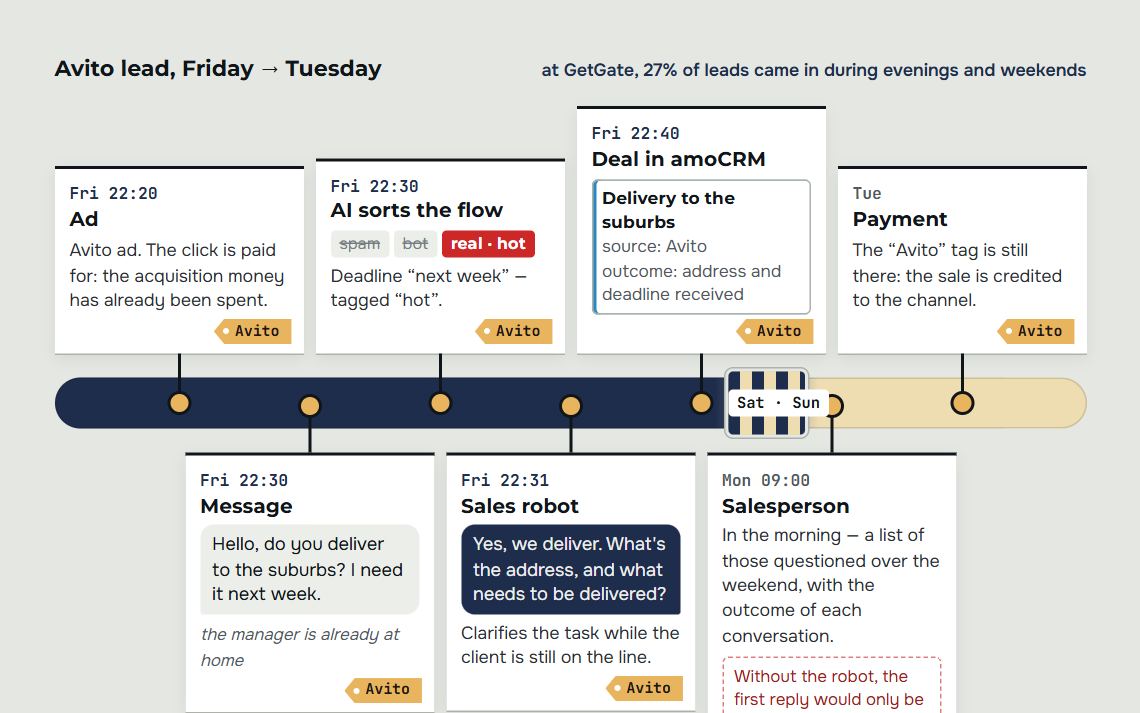
Speed of first response is the one part of a sale where you gain an advantage without any skill at all. A client writes at eleven at night, gets a clear answer within a minute, and keeps talking to you instead of whoever answers in the morning.
The owner of a gate manufacturing company puts it plainly: "Doesn't matter if it's night, day, morning, everything's on fire around — it still answers 'good afternoon.' The faster we respond to clients' enquiries, the better our chances of getting richer."
It's important not to confuse speed with a brush-off. A reply like "your enquiry has been received, a manager will contact you" is worse than silence: it consumes the client's attention and gives nothing back. What works is different — answering the actual question and asking the next one.
Handling inbound: the ones who will never buy
Any incoming flow includes people who've come to the wrong place. Not through any fault of their own — ads are broad, search is imprecise, a friend gave a recommendation. A sales rep has to talk to them politely and figure out what doesn't fit.
The owner of a gate manufacturing company put it more precisely than any textbook: "Wanting to buy a Lada Largus and submitting an enquiry at a Porsche dealership." He also noted the cost of it: "Five minutes with one client, five with another, five with a third — that's already an hour gone. And in that hour you could get plenty of other important things done."
An hour a day is twenty hours a month from a single rep. Spent on conversations that were never going to lead anywhere.
The agent does this sorting on its own, without any irritation: it clarifies the request, politely explains if it's not something we handle, and doesn't drain anyone's mood in the process.
Qualification: who to call first
Filtering out the wrong leads isn't enough. Among the rest, you need to know who matters more — and know it before a manager spends a day working through them in the order they came in.
There's usually one signal: the size of the order to come. And there's no need to ask about budget — most clients won't answer that anyway. What they say on their own is enough. "I have a house in a gated community, I need panoramic gates" — that's one category. "I have an old garage co-op, want to replace the old swing gates" — another. "I'm an architect, a project is coming up, who should I talk to" — back to the first.
The agent sorts enquiries by these markers and tags them in the CRM. From there, a simple rule applies: those with budget and timeline come first, the rest follow. Without this sorting, that order is impossible to keep — enquiries just get handled in the order they arrived.
Illustrative example. No need to ask about budget: clients usually reveal the size of the order themselves — a house, a warehouse, the number of doors, the deadline.
The second, third, and fifth touch
Everyone makes the first contact. What comes next is where money gets lost: the person asked for time to think, promised to come back, went off to talk it over with his wife — and disappeared. And most often he didn’t change his mind — nobody simply wrote to him.
The owner of a gate manufacturing company called this out as a pain point of its own: "the pain of the second, third, fourth, and fifth touch." The owner of a delivery company put it differently: "They submit an enquiry, then we call — they don't pick up. Or we send a proposal — no answer."
Here the machine has an advantage a person doesn't: it doesn't forget, and it doesn't feel awkward. A sales rep feels uncomfortable writing for the fifth time, so they put it off and never come back to it. The agent writes calmly, on time, and to the point — and half of the "vanished" leads respond.
What happens to an enquiry inside the CRM
Sales department automation is not a messenger bot. The bot replies, but the work lives in the CRM, and if nothing reaches it, there is no automation.
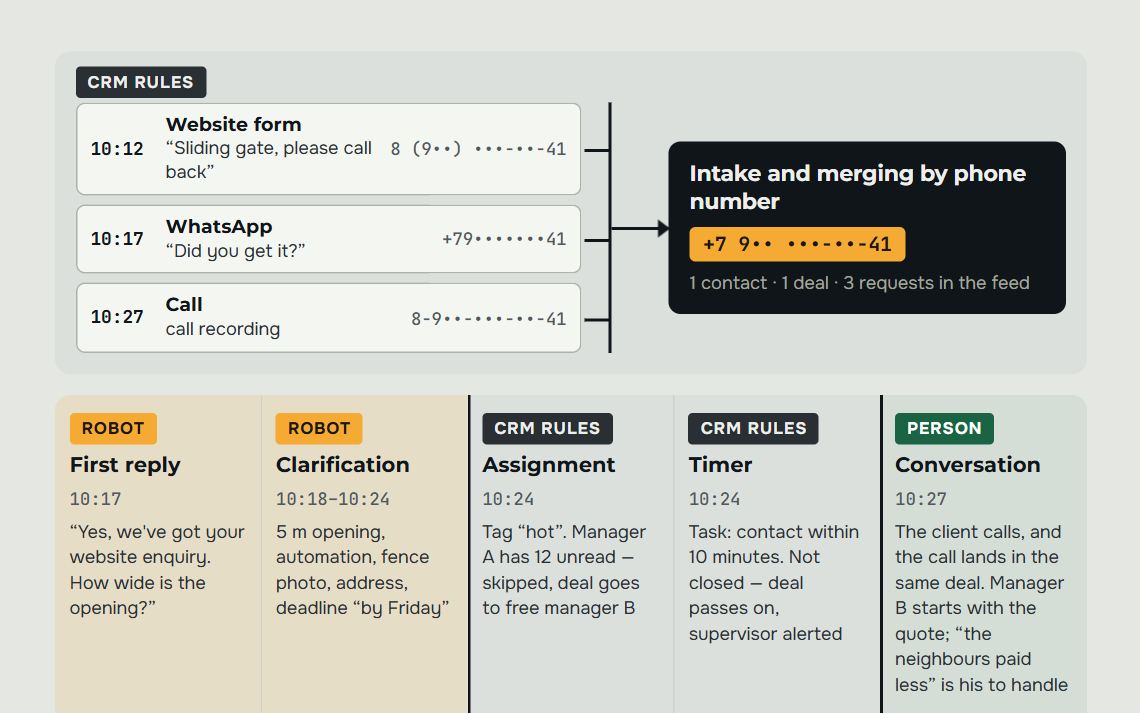
Done right, it looks like this: an enquiry from any channel — the website, WhatsApp, Telegram — becomes one card, not three. The card shows what the person asked, what the agent answered, which category it falls into, and what to do next. The manager opens the card and picks up the conversation where it left off, instead of starting over from scratch.
If the CRM is still empty after the bot goes live and the chats live separately, what was built is an autoresponder. It never got as far as automation.
A plan for the day instead of a task list
The next level begins when the system looks at the entire database, not just new leads. Any company that has been around for a while has hundreds of deals sitting in its CRM that nobody got to: someone was thinking it over, someone was waiting for a quote, someone simply got lost.
You cannot work through this backlog by hand; it is bigger than a working day. For a machine it is doable: every morning it goes through the database and tells you whom to call today and why. The list has two dozen deals instead of a thousand, and each comes with a reason: here an invoice was issued and not paid, here there has been silence for eighteen days after the site measurement, here the customer asked a question and never got an answer.
Illustrative example. The plan is built not from the manager’s memory but from where the money actually is.
The manager gets a plan for the day. It is built around where the money actually is, and there is no longer any need to keep everything in your head.
What not to automate
The exact price. A machine can calculate it from dimensions and parameters, but quoting a final figure to a client without a measurement is a good way to end up in an argument during installation. A ballpark figure is fine — the exact number comes after the measurement.
Deadlines and discounts. These are promises the company keeps, not the agent. It doesn't negotiate them.
A conversation where the person has doubts. When a client hesitates, they need a person. That’s simply how selling expensive things works; it isn’t a weakness of the technology.
And separately: don’t pass the agent off as a human. It comes out, and it comes out badly. People are fine with a program answering them — what irritates them is silence.
Where to start
Not with buying a platform, and not with choosing a model. With a single question: where in your sales department is time spent on work that isn't sales.
The answer usually turns up within ten minutes, and it looks similar for everyone: first reply, sorting incoming enquiries, follow-up touches. That's the first stage.
The first wave, area by area: what to hand to the machine and how to tell it has worked.
| Area | What to automate | Sign that it works |
|---|---|---|
| First reply | A reply that addresses the question, plus the next question to the customer, at any hour | Evening and weekend enquiries get a reply straight away, not at the start of the shift |
| Sorting incoming enquiries | Finding out the task and replying politely to those who came to the wrong place | The manager no longer spends time on conversations that are bound to lead nowhere |
| Qualification | A mark in the CRM based on signs of the future order size and timing | The manager calls those with money and a deadline first, not in order of arrival |
| Follow-ups | Timely, to-the-point messages to those who said they’d “think about it” | Customers who went quiet reply, and every such deal has a next step |
| CRM card | One card per customer from all channels, with the conversation history | The manager picks up the conversation where it left off |
| Daily plan | A morning pass over the whole database, with a reason to call for each deal | The manager has a short list: whom to call today and why |
Next, launch the simplest version and watch it on live chats. The first working version takes days, not months. Its job is to show where your assumptions were wrong. Adding complexity makes sense after that, not before.
Frequently asked questions.
Where does automating a sales department begin?
With identifying where sales reps spend time on things other than selling. Usually that's the first response, handling the inbound flow, and follow-up touches. Starting by buying a platform means solving a problem you haven't defined yet.
Will the agent replace sales reps?
No. It takes on work that isn't actually selling: replying, clarifying, sorting, following up. The conversation where a person decides about money stays with a person.
How long does a rollout take?
The first working version takes days. It answers questions and qualifies the enquiry. After that, you add what real conversations show you.
Do you need to change CRM?
No, the agent is built into the one you already have. If there's no CRM at all, that's a separate job — bolting an agent onto nothing makes no sense.
What happens if the agent answers incorrectly?
It answers based on your materials and hands off everything else to a person. In the first weeks, the conversations are read through in full — that's how you find the spots where it misread a question.
How is this different from a scripted chatbot?
A scripted bot is given questions to ask; an agent is given a goal. A detailed breakdown is available in a separate article: how an AI agent differs from a chatbot.
Let's audit your business
Leave a request and on a free consultation we'll find where customers are being lost, suggest which service to start with and price it around your goal.
Rather not fill in a form? Message our agent on Telegram — it replies right away and books you a review.