What is a sales funnel and how to calculate it
A sales funnel is the client's path from enquiry to payment, broken into stages: at each one you can see how many deals got through and how many dropped off. Calculate the conversion rate between neighbouring stages. The lowest rate shows where you're losing money; most often it's the first reply and the step after sending a proposal.
The sales funnel in plain words
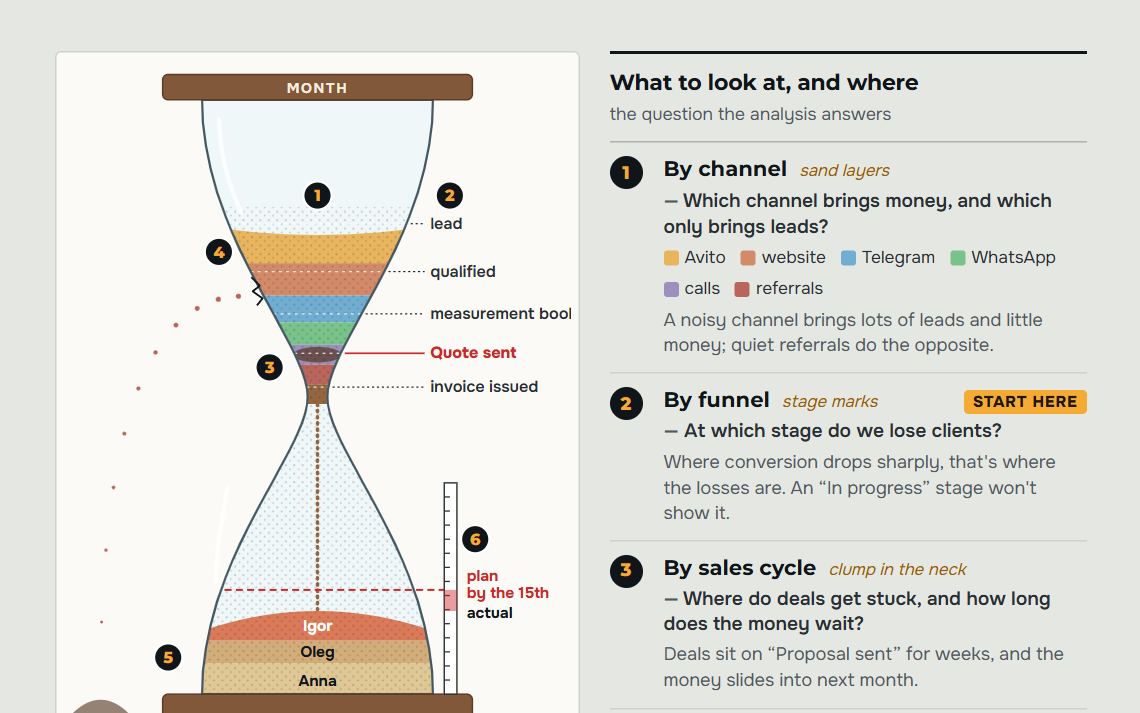
A sales funnel is the client's path from first contact to payment, broken down into stages. At each stage some people drop off: someone asked the price and disappeared, someone got a quote and went away to think it over. So the diagram narrows toward the bottom like a funnel — hence the name.
What the head of sales needs from it is answers to two questions. Where each specific deal is right now and who needs to act on it. And at which step the team loses the most clients. The first is what a manager checks every day; the second is what the owner reviews once a week.
Monday, 10:05. The owner opens the CRM and sees forty deals at the “Negotiation” stage. You can’t tell from the list which are alive and which got stuck last month. A properly built sales funnel answers that question on its own: every deal has a stage, a task and a deadline.
Five stages for services and retail: from lead to payment
If you sell services or goods to private customers, a short scheme almost always fits. It makes a handy base, and it's worth splitting further only when the process really is more complex.
- Enquiry. The client wrote, called or filled in a form. A deal has been created, but nobody has spoken to them yet.
- The first reply. A manager or robot replied, the client responded, the conversation has started.
- Qualification. You've found out the need, timing, budget and who makes the decision. This is where those you're not a fit for drop off.
- Proposal. The client has received a quote, estimate or selection and knows the price.
- Payment. An invoice was issued or a payment link sent, and the money came in.
What it looks like in practice. Thursday, 18:40, a message arrives on Telegram: “Hello, how much is a post-renovation clean of a three-room flat?” That's the enquiry. The manager replies and asks for the floor area and a convenient date — that's the first reply.
The client names Saturday and sends photos of the rooms — qualification done. An hour later she gets a quote with two options — the proposal. A prepayment via a link closes the deal and moves it to “Payment”.
The enquiry and the first response are often glued into a single stage. Keep them separate: it’s the only way to see how many people never got a reply at all. If you have a site visit, a measurement or a trial lesson, add it as a separate stage between qualification and proposal. The rule is simple: you need a new stage wherever the manager’s next action changes.
Calculating stage-to-stage conversion: a hypothetical example
Stage-to-stage conversion is the share of deals that moved from one stage to the next. Divide the number of deals at the next stage by the number at the current one. End-to-end conversion is the share of all leads that made it to payment.
What follows is a hypothetical example: the numbers are made up for the calculation and say nothing about the market or your competitors. In a month, the team received a hundred enquiries.
- ninety got a response — nine out of ten made it through;
- sixty passed qualification — two thirds of those who got a reply;
- thirty received a proposal — half of those qualified;
- ten paid — a third of those who got a proposal.
The end-to-end conversion in this example is one payment per ten enquiries. On its own that figure explains almost nothing: it doesn’t show where the losses are. The shares between stages show it at once. The weakest spot here is the step from proposal to payment, where two thirds drop off. Next comes the gap between qualification and proposal.
Illustrative example: the numbers are made up for the calculation and say nothing about the market. Conversion rate is the number of deals at the next stage divided by the number at the current one; count deals created in the same month.
Look at losses in absolute numbers too. Ten enquiries with no reply are people who already wanted to buy and whom nobody wrote back to. They’re the easiest to win back: no discounts, no new script, just speed. That’s why fixes often start at the top of the funnel, even when the share there looks decent.
Count deals created in the same period. If the September report includes deals started in August, the rates drift: payments from old enquiries pile onto the new ones, and conversion can look better than it really is.
What to count at each stage and where clients are usually lost there.
| Stage | What to count | Typical loss |
|---|---|---|
| Enquiry | How many enquiries came from each channel, including evenings and weekends | Enquiries from channels not connected to the CRM never make it into the report |
| First reply | The share of enquiries that got a reply, and the time it took | The client went with whoever replied first while the manager was out on a job |
| Qualification | The share of clients whose need, timing and budget were established | The client went quiet after the first questions, and there is no follow-up task |
| Proposal | The share of qualified clients who received a quote, and the time spent at the stage | The quote was sent, the client replied “I’ll take a look”, and there is no next step |
| Payment | The share of those with a proposal who paid, and the amount sitting at the stage | The invoice was issued, but nobody checked the payment or reminded the client |
| Closed without a sale | The reason for loss on every closed deal | The reason wasn’t recorded, and a month later nobody remembers why clients left |
Where the funnel leaks most often
Four spots come up in almost every sales team we review. All of them are visible in the CRM in advance, if stages and tasks are set up.
First-reply speed. Wednesday, 11:10, an enquiry from Avito: “Still available? When can you come?” The manager is out on a job and replies at 14:30. By then the client has already agreed with whoever answered first. In the report this looks like “the client disappeared”, even though the delay was on your side.
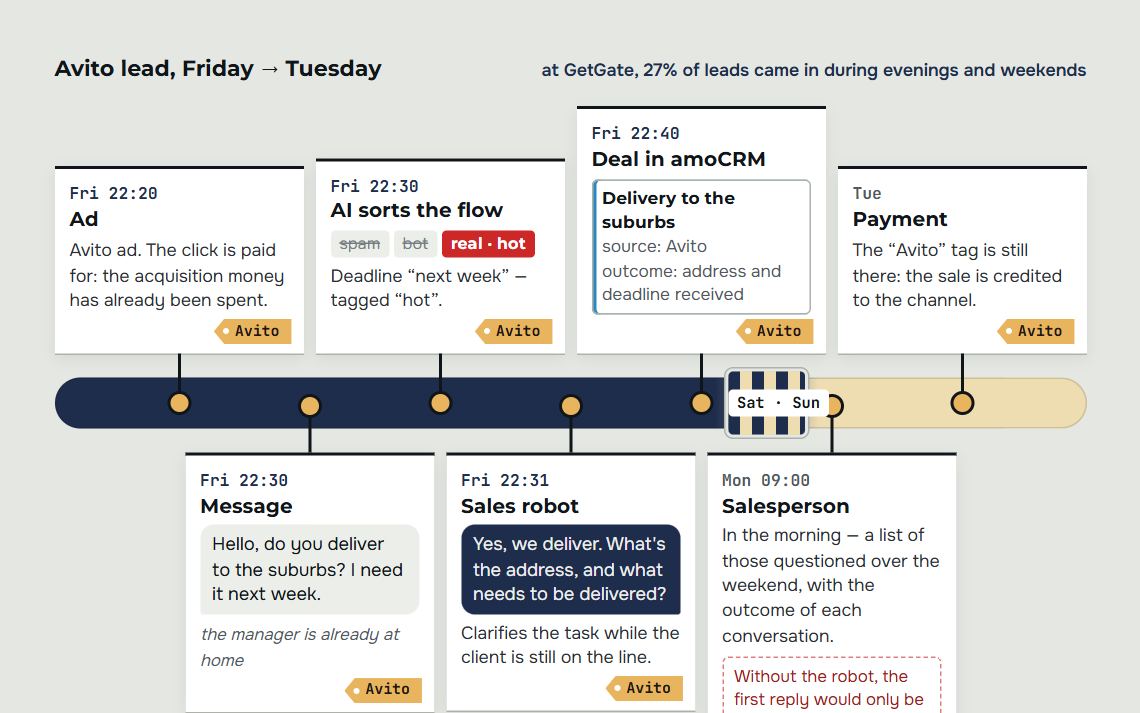
After-hours enquiries. Late in the evening, people write to several companies at once and pick the one that replies. Your morning reply reaches a client who is already in another conversation. In a live GetGate project, 27% of enquiries came in during evenings and weekends, and before the robot was connected they waited until morning. How to close that window is covered in our article on enquiries after the office closes.
No next step. The manager sent a quote on WhatsApp, the client replied “Thanks, I’ll take a look”, and that was it. The deal sits at the “Proposal” stage with no task, and a week later nobody remembers it. That’s usually where a weak step from proposal to payment comes from.
Overdue tasks. There is a task, but its deadline passed three days ago. On paper the deal is under control; in reality nobody is working on it. When overdue tasks number in the dozens, the manager stops noticing them. Why this happens and how to clear the backlog is covered in our piece on overdue tasks in CRM.
How to build a sales funnel in amoCRM around your process
Start with the chats. Take the five to ten most recent paid deals and walk through them from the first message to payment: where there were pauses, where the client hesitated, what they asked. Funnel stages are the points where the manager's next action changes. If the action is the same, merge the two stages.
In amoCRM, leads from connected channels land in “Incoming leads” — that is your “Lead” stage. Then create your own stages from the list above. The final “Closed – won” and “Closed – lost” stages are added by the system itself. For deals closed without a sale, make the loss reason mandatory: without it, a month later nobody will remember why clients walked away.
Set required fields at the stages. To move to “Qualification”: the client's request and the source. For “Proposal”: the amount and the date of the next contact. The amount field also puts money into the report: you see both the number of deals at a stage and how much money is sitting there.
Connect the channels: WhatsApp, Telegram, Avito, website forms and telephony. No enquiry should live on a manager's personal phone: what isn't in the funnel won't show up in any report. We build setups like this as part of amoCRM implementation: a sales funnel built around your process, channels, telephony and automatic tasks.
You need a separate funnel when the process itself is different: repeat sales, wholesale, service. Lump everything into one and the conversion rates get mixed up, and the report stops telling the truth about each line of business.
Automatic tasks at every stage
In amoCRM, stage actions are set up in the Digital Pipeline. When a deal reaches a stage, a rule fires: set a task, change the person responsible, send a message. All the manager has to do is complete the task; there's no need to remember it. A minimal set looks like this.
- Enquiry: a task “reply to the client” with a fifteen-minute deadline. At night the robot replies first, and the task moves to the start of the shift.
- First reply: a task “find out the need, timing and budget” by the end of the day. If the client stays silent for a day, a follow-up task with a ready-made text appears.
- Qualification: a task “prepare a proposal” and required fields before moving on.
- Proposal: a task “call and discuss the quote” for the next working day. If a deal sits at a stage for more than three days, the head of sales gets a notification.
- Payment: a task “check the payment has arrived” on the day the client named, plus a reminder to the client with a payment link.
Friday, 16:50, a client received an estimate and wrote: “I'll discuss it with my wife and get back to you.” On Monday at 10:00 the manager already has a task: “Ask what they decided, offer two dates to choose from.” Nobody had to keep this client in their head all weekend.
The second rule: every open deal has at least one upcoming task. In amoCRM, deals without tasks can be found with a filter, and it's worth opening it every morning. Some of these tasks can be handled by a sales robot: replying to the first message, asking qualifying questions, reminding about payment and handing a client who is ready to buy over to a manager.
Don't set tasks for everything. If each stage has three automatic tasks, the manager starts closing them without looking, and you're back to overdue work. One task per stage, with a clear action and a realistic deadline, works more reliably.
How to read a funnel report
In amoCRM's “Analytics” section there's a “Sales analysis” report: it shows how many deals, and for what amount, sit at each stage. Conversion rates are easier to keep in a separate spreadsheet or dashboard, with stages as columns and months as rows.
Read the report in this order. First, the conversion between neighbouring stages: wherever it's lowest, look there first. Then time at each stage: a deal may keep moving, but so slowly that the client cools off along the way. Then the breakdowns by source and by manager.
The breakdown by manager often explains more than the overall figure. A made-up example: two managers have the same share of payments, but one's clients almost always get as far as the proposal, while half of the other's get stuck at qualification. The first needs his proposals reviewed, the second needs better qualification questions. The overall report won't show that difference.
Illustrative example. In the team's overall row it's the same payment rate; the difference only shows when broken down by manager, and only in the rates between adjacent stages.
Don’t draw conclusions from small numbers. If four deals reached a stage in a week, one extra payment shifts the share by a quarter. Look at a month, or track the direction week on week. Real-time breakdowns by channel and manager, plus alerts when numbers dip, come with sales analytics.
The conversion rate tells you where the leak is, but not why. You find the reason in the conversations themselves. Open ten deals stuck at the weak stage and read the chats: the reason is usually clear by the third one.
Where to start this week
On Monday, export last month's deals and count how many reached each stage. Divide adjacent numbers and you get the transition rates. It takes about an hour, and afterwards it's clear which stage to fix first.
On Tuesday, open two filters: deals without tasks and overdue tasks. Either bring each such card back to life with a dated task or close it with a loss reason. Dead deals make the funnel look fatter than it is, and any forecast based on it lies.
Then set up one automatic task per stage and after a month compare the shares with the starting ones. If the first response turned out weak and enquiries also come in at night, take a look at a robot that replies instantly. If you lose clients after the proposal, start with follow-up tasks: that’s cheaper than any automation.
Frequently asked questions.
How many stages should a sales funnel have?
As many as there are changes in the manager’s next action. For services and retail five is usually enough: enquiry, first response, qualification, proposal, payment.
If you have a site visit, a survey or a demonstration, add it as a separate stage. Better not to create stages like “thinking it over” or “pending approval”: they don't tell you who has to do what, and deals get stuck there.
What funnel conversion rate counts as normal?
There's no single norm: it depends on the niche, the average order value, the lead source and the length of the deal. Average figures from the internet compare things that can't be compared.
Compare the funnel with itself: this month with last month, one channel with another, one manager with another. If the transition rate at a stage falls several weeks in a row, it's time to dig in, whatever the absolute figure.
Can I run a sales funnel in a spreadsheet without a CRM?
You can, as long as there are few enquiries and one person handles them. A spreadsheet will show the rates, but it won't set a task, remind you about overdue ones or collect chats from messengers.
When enquiries come from several channels and two or more people handle them, a spreadsheet falls behind reality: deals get entered after the fact or forgotten. That’s the moment to move to a CRM, such as amoCRM.
How often should you look at the funnel report?
Managers daily, looking at their own deals without tasks and with overdue tasks. The head of sales weekly, comparing conversion rates with the previous week.
A full review with breakdowns by channel and manager is best done once a month, using deals created that month. That way the figures don't get mixed up with leftovers from earlier periods.
Do repeat sales need a separate funnel?
Yes, if a repeat sale goes differently from the first one. A regular client doesn't need qualification, but does need a reminder when it's due and an offer of something new.
In a shared funnel the conversion rates get mixed up: repeat customers buy more readily and flatter the report on new enquiries. A separate funnel with short stages fixes this and helps you not forget those who have already paid.
Let's audit your business
Leave a request and on a free consultation we'll find where customers are being lost, suggest which service to start with and price it around your goal.
Rather not fill in a form? Message our agent on Telegram — it replies right away and books you a review.